Can Light Help Ease Anxiety and Depression? A Case Series on tPBM
![[object Object]](https://cdn.sanity.io/images/h29o7kl4/staging/0c0476690b5e49f9a375deb663c4d52aa39fa8e2-352x351.heif?w=352&q=80&auto=format&fit=max)
When it comes to supporting patients with anxiety and depression, nutrition and lifestyle changes are often the first line of defense. Diet, exercise, therapy, and supplements can all make a big difference - but sometimes, even with all the right steps in place, symptoms continue without relief.
That’s what led Jana Jamail, certified nutrition specialist to explore transcranial photobiomodulation (tPBM) - a non-invasive brain stimulation technique using near-infrared light - for her patients. In a recently published case series, she shared how three patients with persistent anxiety and depression experienced positive changes after 12 weeks of using Neuronic’s Neuradiant 1070 helmet, a transcranial near-infrared light device used for brain health.
Why Near Infrared Light?
When therapy, medication, lifestyle changes, and nutrition don’t bring sufficient relief, patients are often left feeling discouraged. What makes tPBM promising in the field of depression and anxiety research is that it is repeatedly being demonstrated through published studies in journals like Nature and Frontiers in Neuroscience, that targeted light at specific wavelengths can support brain energy production, calm neuroinflammation, and restore balance to brain signaling. These are major factors to brain health that are highly implicated in mental health conditions like anxiety and depression.
The protocol used here is seen below:
- Device: Neuradiant 1070 helmet (1070 nm wavelength, 256 LEDs)
- Protocol: 10 Hz, 75% intensity, 10–15 minutes per day
- Duration: 12 weeks
Assessments included a Cognifit test at baseline and again at 12 weeks, along with the Generalized Anxiety Disorder-7 (GAD-7) and the Depression, Anxiety and Stress Scale- 21 (DASS-21) questionnaires administered at baseline, six weeks, and 12 weeks. In addition, participants tracked sleep, mood, and potential side effects throughout the study.
The Three Participants
Case One: 35-year-old Female with ADHD, Anxiety and Depression
A 35-year-old woman with ADHD, anxiety, and depression had been in therapy for five years and trying EMDR for six months, but still struggled to find relief. Despite following a balanced diet and taking supplements, her symptoms persisted. She was using Lexapro and Vyvanse (doses not recorded) and relied on THC at night to help her sleep.
Results:
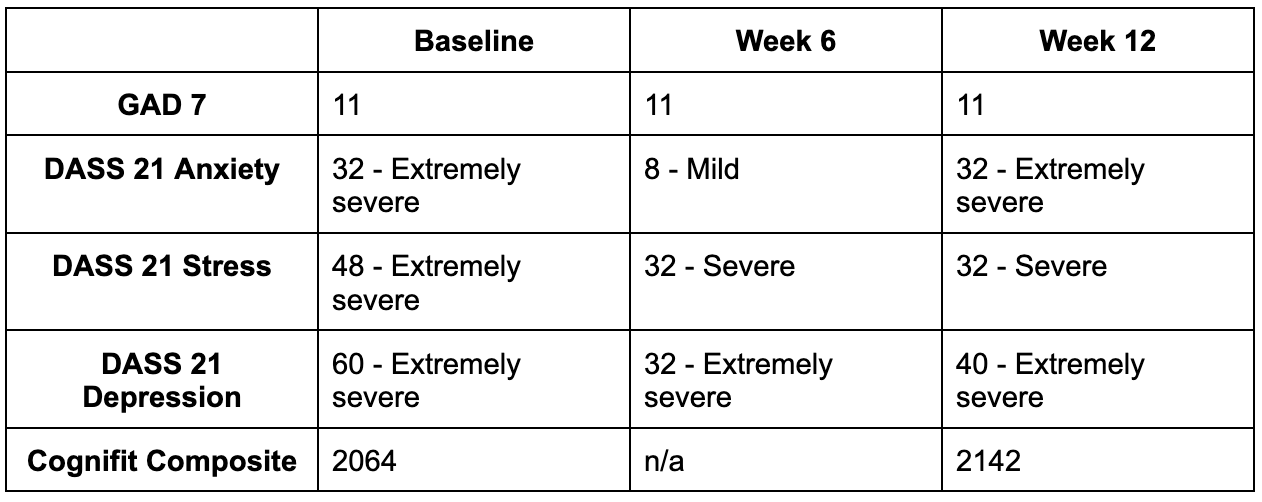
By week twelve, the participant mostly maintained improvements in stress and depression, while anxiety returned to baseline. GAD-7 and cognitive scores showed no significant change throughout the study. Qualitatively, she reported better sleep and less irritability during the program, but she attributed those improvements to restarting Vyvanse about six weeks earlier rather than to the helmet.
This case illustrates a well-documented pattern in depression: even when symptoms improve, some people discount or misattribute those gains because of cognitive distortions, limited interoceptive awareness, or attribution biases linked to personality features (Eggart et al., 2019). Individuals with avoidant or dependent traits may struggle to recognize or integrate positive change - especially when it challenges long-held narratives of helplessness or victimhood, resulting in cognitive dissonance. In practice, this means people vulnerable to distorted self-perception may not perceive benefits from tPBM, even when objective measures show improvement.
Case Two: 35-year-old Female with Anxiety and Healthy Lifestyle
Another 35-year-old patient lived an objectively very healthy lifestyle: Mediterranean diet, daily exercise, therapy, and a strong social network–yet her anxiety remained.
Results:
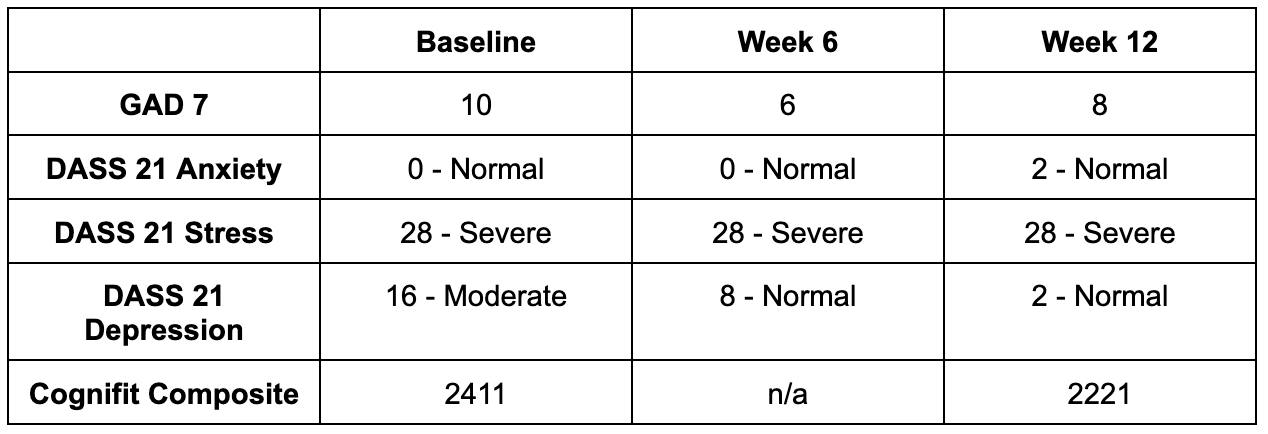
By week twelve, DASS-21 anxiety improved significantly, shifting from the moderate to normal range, and depression showed a clear improvement. Stress ended slightly higher than baseline, while GAD-7 and Cognifit scores showed no significant overall change. Qualitatively, she noticed an improved mood, less anxiety and rumination, and improved sleep starting within the first five days, and those gains held through week twelve.
Case Three: 45-year old Female with Anxiety, Depression, and Trauma-Related OCD
A 45-year-old woman had long struggled with anxiety, depression, and trauma-related OCD. After years of therapy and EMDR with little relief, she started an SSRI a week before trying the helmet. It wasn’t until adding tPBM that she began noticing real change.
Results:
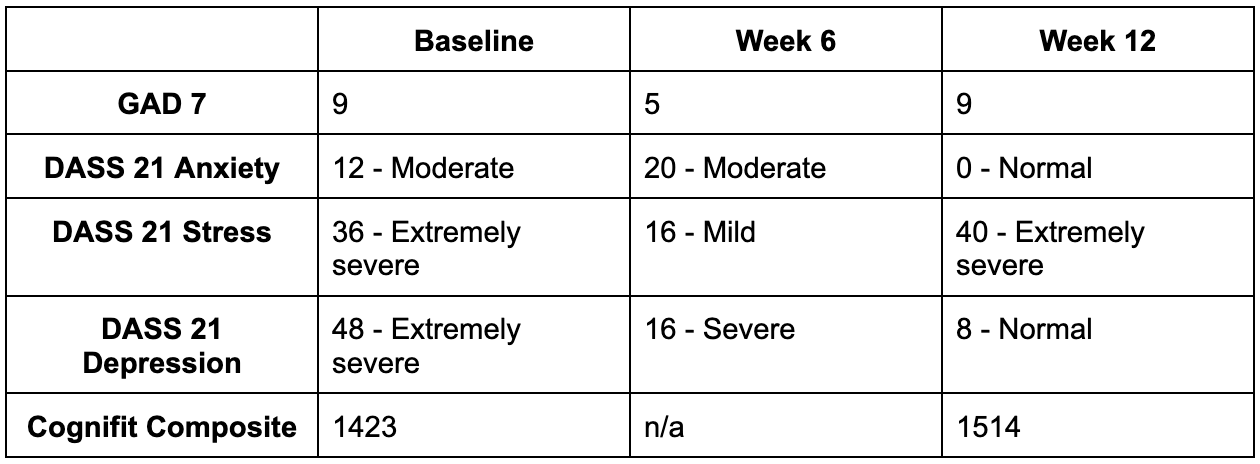
By week twelve, DASS-21 anxiety improved from the moderate to normal range, and depression showed a clear, meaningful improvement. Her stress score ended slightly higher than baseline, while her GAD-7 and Cognifit scores remained largely unchanged. Subjectively, within just five days, she felt calmer, was sleeping through the night, and even started meditating - something she’d been too anxious to do before. By the end of the study, her depression scores were back in the normal range.
Result Trends - What Stood Out
- Sleep improved first. All three patients noticed better sleep within the first week. Since deep sleep is essential for brain recovery, this may have played a big role in their progress.
- Mood followed second. Reductions in anxiety and depression symptoms were reported after just a few days to weeks of use.
- Side effects were minimal. A few patients experienced mild headaches or dehydration if they used the helmet too long, but hydration and electrolytes resolved these issues.
- Consistency mattered. Benefits were strongest when patients stuck to the 10–15 minute daily sessions.
How Might It Work?
Chronic stress is detrimental even down to a cellular level, causing a build up of glutamate (Zhang et al., 2021). Taken with reduced expression of the glutamate transporter GLT-1, this glutamate buildup increases neurotoxicity, further weakens synapses, and downregulates mRNA expression. After sessions of transcranial photobiomodulation, these changes have been shown to reverse: astrocyte function and GLT-1 improve, cytochrome-c oxidase activity and nitric oxide signaling increase, and mitochondrial ATP production and neurotransmitter release recover (Zhang et al., 2021; Eshaghi et al., 2019; Ji et al., 2024).
What Could This Mean for People with Anxiety and Depression?
This case series only involved three people, but the changes were meaningful, especially for individuals who had already tried everything else. While more large-scale research is needed, these stories highlight how tPBM could be a valuable tool for people with therapy-resistant anxiety and depression. Additionally, this study shows the value of using tPBM in tandem with other modalities, which can help providers take an integrative approach to treatment options.
For clinicians and patients alike, the message is hopeful: sometimes, the addition of light can make all the difference.
References:
Eshaghi, E., Sadigh-Eteghad, S., Mohaddes, G., & Rasta, S. H. (2019). Transcranial photobiomodulation prevents anxiety and depression via changing serotonin and nitric oxide levels in brain of depression-model mice: A study of three different doses of 810 nm laser. Lasers in Surgery and Medicine, 51(7), 634–642. https://doi.org/10.1002/lsm.23082 PubMed
Eggart, M., Lange, A., Binser, M. J., Queri, S., & Müller-Oerlinghausen, B. (2019). Major depressive disorder is associated with impaired interoceptive accuracy: A systematic review. Brain Sciences, 9(6), 131. https://doi.org/10.3390/brainsci9060131 MDPI
Ji, Q., Yan, S., Ding, J., Zeng, X., Liu, Z., Zhou, T., Wu, Z., Wei, W., Li, H., Liu, S., & Ai, S. (2024). Photobiomodulation improves depression symptoms: A systematic review and meta-analysis of randomized controlled trials. Frontiers in Psychiatry, 14, 1267415. https://doi.org/10.3389/fpsyt.2023.1267415 Frontiers
Zhang, D., Shen, Q., Wu, X., & Xing, D. (2021). Photobiomodulation therapy ameliorates glutamatergic dysfunction in mice with chronic unpredictable mild stress-induced depression. Oxidative Medicine and Cellular Longevity, 2021, Article 6678276. https://doi.org/10.1155/2021/6678276
Get Your Custom PBM Integration Strategy – Built for Clinicians and Other Professionals
In 15 minutes, you’ll walk away with a clear plan to implement PBM safely, compliantly, and without disrupting client care.
Or Give us a Call: +1 (209) 268-7839