Measuring Brain Health: What CogniFit Data Reveals About Memory, Focus, and PBM
![[object Object]](https://cdn.sanity.io/images/h29o7kl4/staging/0c0476690b5e49f9a375deb663c4d52aa39fa8e2-352x351.heif?w=352&q=80&auto=format&fit=max)
What is Cognition?
We often track our steps, sleep, and even heart rate, but how often do we track the health of our cognition?
Cognition generally refers to “all the activities and processes concerned with the acquisition, storage, retrieval and processing of information regardless of whether these processes are explicit or conscious” (Byrne & Bates, 2006). Cognition plays an integral role in our day-to-day functioning, from maintaining focus at work to recalling a recent conversation with a friend. Due to its central role in our daily lives, it is imperative to ensure optimal cognitive functioning and use accurate tools to measure it.
Measuring Cognition
Cognition encompasses how we think, learn, remember, and interact with the world, and it can be measured through numerous metrics and methods. One such method is CogniFit. The CogniFit platform works by administering a series of tasks and activities that assess cognition by breaking it down into five major domains: reasoning, memory, attention, coordination, and perception.
What Is CogniFit and How Does It Work?
The CogniFit platform is used both in research in clinical settings to evaluate cognition and train cognitive domains. In total, Cognifit analyzes 22 different cognitive skills, ranging from processing speed to spatial reasoning, and produces a report showcasing an individual's specific strengths and weaknesses.
Cognifit reports are utilized to clearly communicate information about an individual's cognitive performance across a variety of domains, which can help educate the user or researcher on an individual's present cognitive state and progress over time. CogniFit categories include:
- Reasoning:
- Planning
- Processing speed
- Shifting
- Memory:
- Phonological short term memory
- Contextual memory
- Naming
- Short term memory
- Non verbal memory
- Visual short term memory
- Working memory
- Attention:
- Divided attention
- Focussed attention
- Inhibition
- Updating
- Coordination:
- Hand-eye coordination
- Response time
- Perception:
- Auditory perception
- Estimation
- Recognition
- Spatial perception
- Visual perception
- Visual scanning
Viewing cognition from its various domains is important because it provides a window into reflecting both quality of life and brain health. Improvements in areas like attention, planning, and memory can translate into real benefits–whether that's the ability to focus more easily at work, recall information clearly, or better adapt to life’s daily challenges. With tools like CogniFit and interventions like photobiomodulation (PBM), we can track and support these changes in meaningful, measurable ways.
Our Analysis of Cognition: Who Was Studied
This analysis involved retroactively reviewing data of 20 Neuronic users who partook in the consultation process and/or related case studies. As part of this process, clients were asked to take a “pre” Cognifit test to generate a baseline measurement before starting transcranial PBM (tPBM), and a “post” CogniFit test after 3 months of tPBM to track the changes in cognition. Client demographics varied widely, including varying spanning various ages, races, diagnoses, and gender. Nine participants were male, and 10 were female (1 unspecified), ranging from ages 20-76, with the majority living in the United States (19) and one in Brazil.
Key Findings: Where We Saw the Biggest Gains in Cognition
The analysis of this cohort showcased improvements in multiple cognitive domains. Some of the key findings are stated below:
- While all 5 main categories showed some improvements, 11 of the 22 CogniFit skill scores showed statistically significant improvements. The strongest effects were found in working memory, contextual memory, auditory perception, planning, recognition, spatial perception, updating, and visual perception.
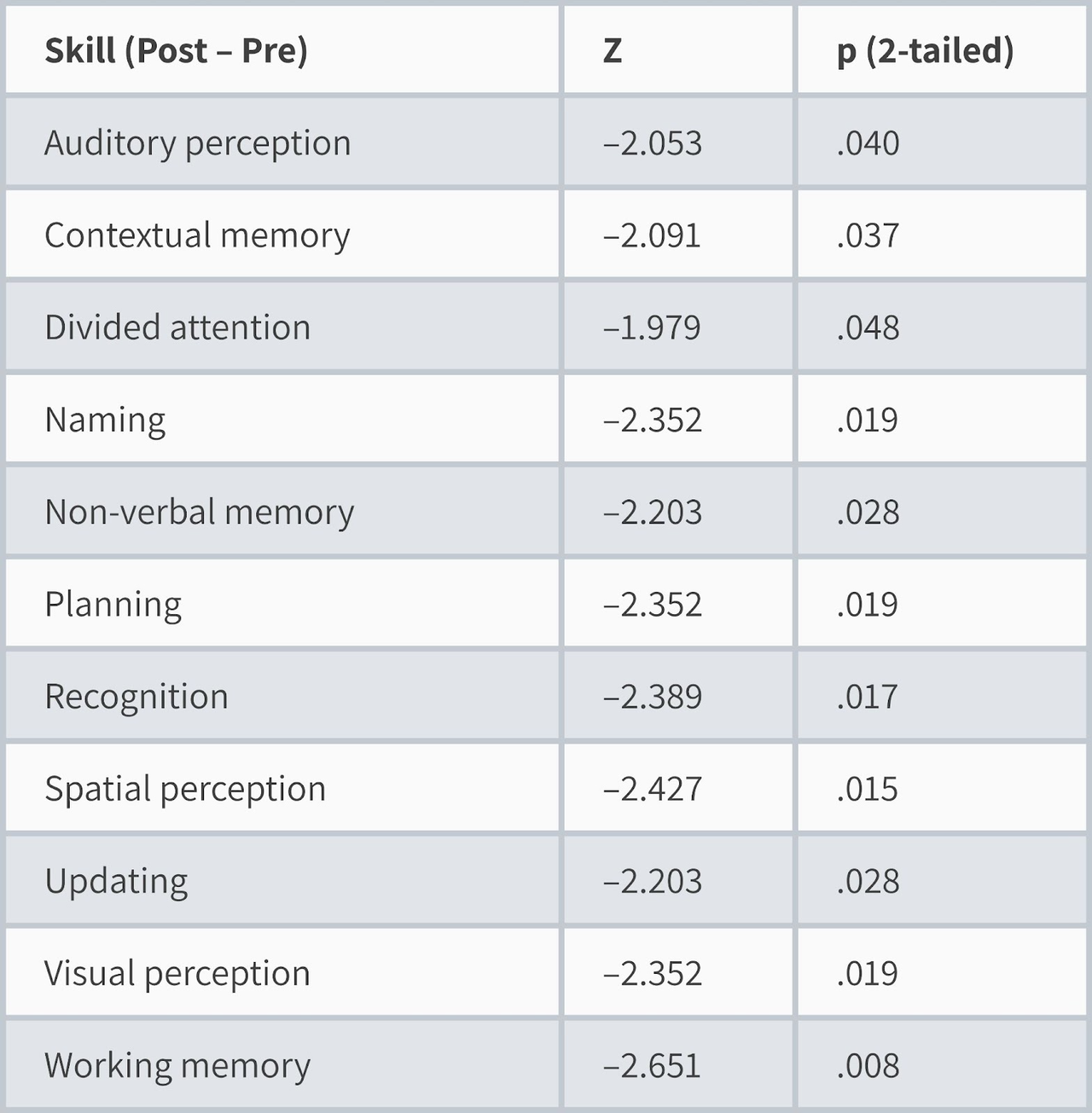
- Analysis shows that individuals with lower baseline functioning tend to exhibit the greatest gains. This was seen in 17 of the 22 skill sets analyzed.
- An association was found between participants who reported regular exercise at baseline and significant improvements in both auditory perceptions and processing speed compared to those who did not report regular exercise. Moreover, we noted a correlation between individuals who rated their physical and psychological health as good and significant gains in auditory perception compared to those who did not.
Lower Scores Improved the Most
Cognitive Improvement
From the analysis we see that clients showed significant cognitive improvement across multiple domains after using PBM. This is unsurprising due to the amount of research into PBM and cognition among both healthy and cognitively impaired individuals. For example, working memory improvement was seen to be statistically significant in our analysis. Similar findings were shown by Qu et al. (2022), demonstrating that tPBM not only improved working memory measured by cognitive testing, but that these results can last up to three weeks after the last tPBM session.
Divided Attention and Working Memory
Divided attention is also commonly referred to as “multitasking.” In addition to cognitive improvement, our analysis found improvements in divided attention which includes the ability to focus on and process multiple tasks, stimuli, or sources of information at the same time.
A 2025 study by Lai et al. examining attention and working memory in adults with ADHD found significant improvements in these domains after just 7 days of tPBM. Furthermore, this study also found that a lower baseline performance predicted greater improvement (2025). This aligns with our second main finding showing lower baseline scores resulting in greater improvements in 17 of the 22 categories, including the domains of working memory and attention.
Why might these findings be true?
One hypothesis is due to the existence of the ceiling effect, whereby individuals who already perform well at baseline have less room to improve. In turn, this makes the relative improvement more dramatic in lower-functioning participants. Another hypothesis is that individuals who score lower may have greater levels of mitochondrial dysfunction.
It is unsurprising that the efficiency of our internal biology would be reflected in measurable outcomes, such as those measured in CogniFit. An individual who scores lower on the CogniFit test may also be someone experiencing mitochondrial dysfunction, as mitochondrial dysfunction is linked to cognitive decline (Apaijai et al., 2020). PBM may be providing a proportionally larger "boost" to individuals experiencing mitochondrial dysfunction compared to healthy individuals, resulting in more significant changes in scores.
Exercise, Brain Health, and PBM
Our analysis revealed an association between participants who reported regular exercise habits at baseline and significant improvements in both auditory perception and processing speed after using PBM compared to those who did not report regular exercise. Auditory perception is the brain’s ability to interpret information from the ears, while processing speed refers to the time it takes an individual to do a mental task. While our analysis found that regular exercise only impacted these two domains, there are n several studies linking exercise to cognitive skills.
Kearns et al., (2019) found that as little as a single 30 minute session of cycling resulted in improved speech perception from baseline to post-workout. Similarly, one study by Collins et al (2025) found that time spent in moderate-to-vigorous physical activity greatly influenced cognitive performance, with significant results reported in processing speed. The improvements reported in this analysis could provide further support of a synergistic relationship between PBM and exercise. While theoretically physical activity should impact cognition at large, there is also evidence to support the fact that it plays a role in auditory perception and processing speed specifically.
How do these findings relate to qEEG findings? Future research
A quantitative encephalogram (qEEG) is a common neuroimaging test that records the electrical activity in the brain. Many researchers over the years have correlated specific patterns of electrical activity in the brain with clinical symptoms or subjective experiences.
Case Spotlight:
A case study review of one client from this analysis was conducted in order to assess if there is a relationship between changes in Cognifit scores and changes in qEEG over the same time period. After 3 months of PBM, this client showed significant improvements in multiple cognitive skills. With the highest possible score being 100, the largest gains were in auditory perception (+51), contextual memory (+37), non-verbal memory (+31), visual short-term memory (+30), and working memory (+29). Strong progress was also seen in planning (+25), overall memory (+22), and inhibition (+20), pointing to broad enhancement of both executive and memory functions.
These cognitive results are further supported by the EEG. In the eyes' open recording condition, the absolute power of both theta and beta bins and a modest decrease in the theta-to-beta ratio moved closer to the mean. Researchers have shown that regulation of these patterns specifically has been linked to improvements in attention (Putman et al., 2013). This aligns with the participant’s noted improvements in attention-related skills such as focus, inhibition, and working memory.
In contrast, during the eyes-closed recording condition, the relative increase in the theta-to-beta ratio suggests the participant may have entered a state of deeper relaxation and lower arousal, possibly reflecting an improved neural adaptability to appropriately shift states - an important factor for memory consolidation and cognitive recovery. Additional EEG markers further support these changes: a faster peak alpha frequency moving closer to the mean, possibly indicating enhanced information-processing speed, and greater regulation of delta activity in the frontal and central regions, possibly reflecting a shift toward a clearer, more efficient cortical state.
Taken together, the improved Cognifit scores and pre to post EEG results may provide further support that once the participant started use of tPBM, they not only experienced measurable cognitive gains but possibly demonstrated underlying neurophysiological improvements. The combination of improved scores across attention, memory, and executive cognitive skills and the noted regulation in the EEG could support this participants movement toward a more efficient, resilient, and adaptable state of wellbeing.
What This Means for the Future of Brain Health
Overall, this analysis highlights how photobiomodulation, measured through CogniFit testing, can potentially result in meaningful gains across a wide range of cognitive domains. The improvements seen in memory, attention, perception, and executive functioning - especially among those with lower baseline scores - mirror what has been observed in broader PBM research. Combined with lifestyle factors like exercise, which may further enhance specific domains such as processing speed and auditory perception, these findings suggest that cognitive health can be supported through both targeted interventions and everyday habits. As research continues to grow, PBM stands out as a promising, non-invasive tool for promoting healthier brain function and improving quality of life.
References:
Apaijai, N., Sriwichaiin, S., Phrommintikul, A., Jaiwongkam, T., Kerdphoo, S., Chansirikarnjana, S., Thongmung, N., Mahantassanapong, U., Vathesatogkit, P., Kitiyakara, C., Sritara, P., Chattipakorn, N., & Chattipakorn, S. C. (2020). Cognitive impairment is associated with mitochondrial dysfunction in peripheral blood mononuclear cells of elderly population. Scientific Reports, 10, Article 21400. https://doi.org/10.1038/s41598-020-78551-4
Collins, A. M., Mellow, M. L., Smith, A. E., Wan, L., Gothe, N. P., Fanning, J., Jakicic, J. M., Kang, C., Grove, G., Huang, H., Oberlin, L. E., Migueles, J. H., Kamboh, M. I., Kramer, A. F., Hillman, C. H., Vidoni, E. D., Burns, J. M., McAuley, E., & Erickson, K. I. (2025). 24-hour time use and cognitive performance in late adulthood: Results from the Investigating Gains in Neurocognition in an Intervention Trial of Exercise (IGNITE) study. Age and Ageing, 54(4), Article afaf072. https://doi.org/10.1093/ageing/afaf072
Current Biology. (2006). Why are animals cognitive?. Current Biology, 16(12), Pages. https://doi.org/10.1016/S0960-9822(06)01623-X
de Freitas, L. F., & Hamblin, M. R. (2016). Proposed mechanisms of photobiomodulation or low-level light therapy. IEEE Journal of Selected Topics in Quantum Electronics, 22(3), 7000417. https://doi.org/10.1109/JSTQE.2016.2561201
Lai, Q.-J., Chen, Y., Liu, L., Li, H.-M., Pan, M.-R., Wang, Y.-F., Niu, H.-J., & Qian, Q.-J. (2025). Repetitive transcranial photobiomodulation improves working memory and attention in adults with ADHD: A 4-week follow-up study. Photobiomodulation, Photomedicine, and Laser Surgery, 43(5), 190–197. https://doi.org/10.1089/photob.2025.0008
Kearns, L., Rich, A., Pita, N., & Okada, K. (2019). Spin: The effects of acute exercise on speech perception. Psychology and Behavioral Sciences, 8(3), 67–71. https://doi.org/10.11648/j.pbs.20190803.12
Qu, X., Li, L., Zhou, X., Dong, Q., Liu, H., Liu, H., Yang, Q., Han, Y., & Niu, H. (2022). Repeated transcranial photobiomodulation improves working memory of healthy older adults: Behavioral outcomes of poststimulation including a three‑week follow‑up. Neurophotonics, 9(3), 035005. https://doi.org/10.1117/1.NPh.9.3.035005
Putman, P., Verkuil, B., Arias-Garcia, E., Pantazi, I., & van Schie, C. (2013). EEG theta/beta ratio as a potential biomarker for attentional control and resilience against deleterious effects of stress on attention. Cognitive, Affective, & Behavioral Neuroscience, 14(2), 782–791. https://doi.org/10.3758/s13415-013-0238-7

Neuronic LIGHT
$1,795
At-home near-infrared brain stimulation designed to support clarity, focus, and long-term cognitive wellness.
- 90-Day Return Policy
- Backed by Research
- Free Shipping
- One Year Warranty