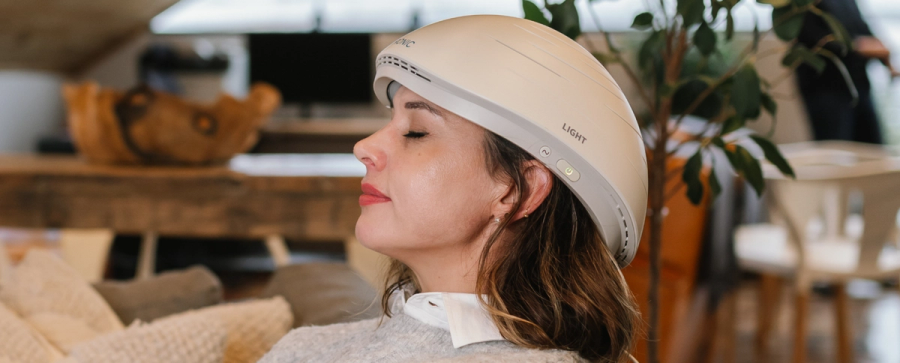
Better Focus, Faster: TMS + Light Therapy Together
![[object Object]](https://cdn.sanity.io/images/h29o7kl4/staging/0c0476690b5e49f9a375deb663c4d52aa39fa8e2-352x351.heif?w=352&q=80&auto=format&fit=max)
Introduction
In recent years, non-invasive brain stimulation therapies have transformed how clinicians and researchers approach mental health. Two leading methods - Transcranial Magnetic Stimulation (TMS) and Photobiomodulation (PBM), often called light therapy - are showing remarkable promise in supporting brain health, mood regulation, and neuroplasticity.
While each therapy has unique strengths, emerging studies suggest that combining TMS and PBM may produce synergistic effects, enhancing both cortical activation and mitochondrial energy metabolism. This dual approach could pave the way for more effective, personalized brain-based interventions.
What Is Transcranial Magnetic Stimulation (TMS)?
TMS is a safe, non-invasive neuromodulation technique that uses magnetic fields to stimulate targeted brain regions. By placing a magnetic coil near the scalp, TMS delivers rapid pulses that induce small electrical currents within cortical tissue, prompting neurons to fire and modulating neurotransmitter release.
Clinically, TMS is FDA-approved for major depressive disorder, obsessive compulsive disorder and smoking cessation and is being studied for conditions such as PTSD, anxiety, tinnitus, and cognitive impairment.
Patients often describe the sensation as light tapping or muscle twitching beneath the coil. Common side effects, like scalp discomfort or mild headaches, are typically short-lived. Because there is no anesthesia or downtime, most individuals can resume normal activities immediately after a session.
How Does TMS Work?
TMS works by influencing cortical excitability - essentially, how easily neurons activate. During treatment, clinicians first identify a person’s motor threshold, or the minimum amount of stimulation required to produce a visible muscle twitch. This “dose” helps individualize treatment intensity.
When applied to specific brain regions (such as the left dorsolateral prefrontal cortex for depression), TMS can “wake up” underactive networks, similar to setting off an internal alarm clock for neurons that have fallen asleep. Over time, repeated stimulation helps retrain neural pathways, allowing the brain to regulate itself more efficiently even after treatment ends.

How Are PBM and TMS Different?
Though both TMS and PBM are forms of neuromodulation, they operate through very different mechanisms:
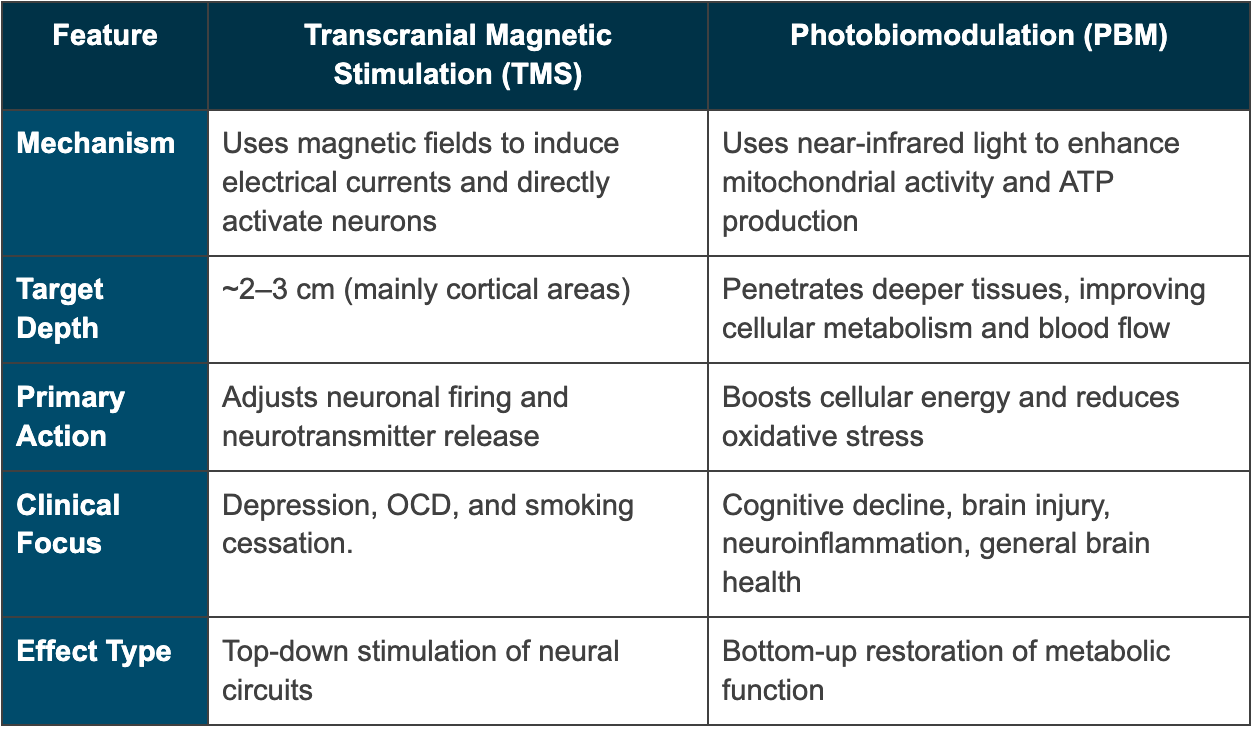
In short: TMS excites, while PBM energizes. TMS helps neurons fire; PBM helps them fire better.
Using TMS and PBM Together: Evidence and Emerging Research
Combining TMS and PBM may create a “top-down and bottom-up synergy” - simultaneously activating brain circuits (TMS) while fueling the mitochondria that power them (PBM). Early research supports this idea.
1. PBM Can Regulate Cortical Excitability Before TMS
A 2013 study by Konstantinovic et al. (2013) found that applying near-infrared PBM over the motor cortex temporarily reduced cortical excitability for about 30 minutes. This suggests PBM can fine-tune neuronal responsiveness, potentially stabilizing overactive regions or preparing the brain for more controlled stimulation such as TMS.
2. PBM + TMS are Better Together
A case study explored the use of personalized repetitive transcranial magnetic stimulation (PrTMS) combined with tPBM in an individual with co-occurring traumatic brain injury (TBI) and post-traumatic stress disorder (PTSD). PrTMS targeted individualized sites (Cz, Fz, F3, F4) at 10 Hz for five weeks, followed by tPBM applied to the frontal region (FPz) at 10 Hz. While improvements were observed with TMS alone, the addition of tPBM led to greater and accelerated gains, suggesting a synergistic effect between the two neuromodulation techniques.
3. TMS + PBM for Mild Cognitive Impairment (MCI)
A 2025 randomized controlled trial by Han et al. evaluated 86 participants with MCI. Those receiving combined TMS and PBM demonstrated significantly greater improvements in MoCA and MMSE scores, as well as increased functional connectivity on fMRI, compared to single-modality or sham groups. The researchers concluded that PBM may enhance the brain’s capacity to adapt to TMS stimulation through complementary pathways.
The Science in Summary
Across multiple studies, the pattern is consistent:
- TMS activates neural circuits through magnetic induction.
- PBM sustains neuronal function by improving mitochondrial efficiency and blood flow.
- When used together, they produce stronger, longer-lasting changes in cortical activity, mood regulation, and cognition.
Rather than competing, these modalities appear to work hand-in-hand, addressing both the functional and metabolic layers of brain health. This integration reflects a new era of neuromodulation - one that unites electrical activation with biological repair.
Key Takeaways
- TMS uses magnetic pulses to directly stimulate underactive brain regions.
- PBM (light therapy) enhances mitochondrial energy and supports cellular repair.
- Together, they may amplify neuroplasticity, improve memory, and accelerate recovery in conditions like depression, tinnitus, PTSD, and MCI.
- Combining top-down (TMS) and bottom-up (PBM) approaches may lead to faster adaptation and more durable outcomes.
References:
Han D, Li Z, Zhang J, Xie P. Effects of Combined Transcranial Magnetic Stimulation and Photobiomodulation in Mild Cognitive Impairment: A Randomized Controlled Trial. J Biophotonics. 2025 Aug;18(8):e70019. doi: 10.1002/jbio.70019. Epub 2025 Apr 20. PMID: 40254536.https://doi.org/10.22541/au.172589645.50046824/v1
Konstantinović, L. M., Jelić, M. B., Jeremić, A., Stevanović, V. B., Milanović, S. D., & Filipović, S. R. (2013). Transcranial application of near-infrared low-level laser can modulate cortical excitability. Lasers in Surgery and Medicine, 45(10). https://doi.org/10.1002/lsm.22190
Mahajan, S., Bodahanapati, A., Katta, A., Aydemir, E., Mendoza, A., Vigilia, C., Blum, K., Baron, D., Lewdandrowski, K. U., Badgaiyan, R. D., & Sunder, K. (2024). Personalized repetitive transcranial magnetic stimulation (PrTMS) coupled with transcranial photobiomodulation (tPBM) for co-occurring traumatic brain injury (TBI) and post-traumatic stress disorder (PTSD). Authorea.
Co-authors
![[object Object]](https://cdn.sanity.io/images/h29o7kl4/staging/dd68c96327aecf6b92de37043b747c350b5f72ff-1194x1194.png?w=1194&q=80&auto=format&fit=max)
Get Your Custom PBM Integration Strategy – Built for Clinicians and Other Professionals
In 15 minutes, you’ll walk away with a clear plan to implement PBM safely, compliantly, and without disrupting client care.
Or Give us a Call: +1 (209) 268-7839