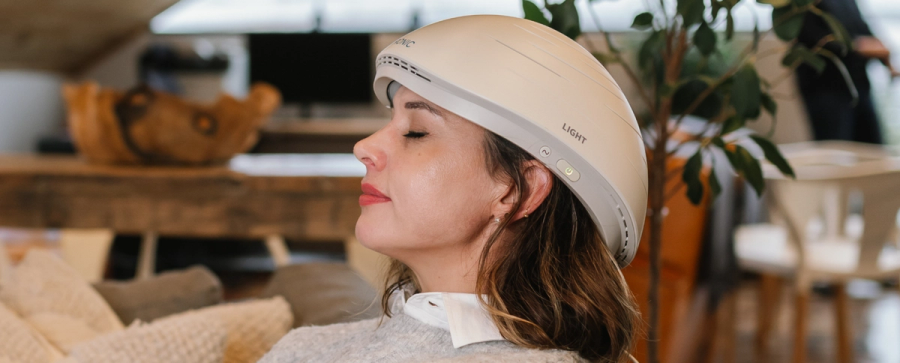
We Gave 25 APOE4 Carriers a Neuronic LIGHT for 4 Months. Here’s What Their Brains Did.
![[object Object]](https://cdn.sanity.io/images/h29o7kl4/staging/10b23cd371e0bdc7ef8d7c53e0d9af11bdbfdf53-2043x2043.png?w=1440&q=80&auto=format&fit=max)
We Gave 25 APOE4 Carriers a Neuronic LIGHTfor 4Months. Here’s What Their Brains Did.
A real-world look at what daily Neuronic LIGHT sessions did for APOE4 carriers living normal lives, tracked continuously for four months. The wins and the limits, with nothing hidden.
A question worth asking
Here is a question most brain-health content skips.
The big prevention studies happen in tightly controlled trials:Selected participants, fixed protocols, clinical-grade equipment, and a short, funded window. They are built to answer one thing: can this work, in ideal conditions?
But you do not live in ideal conditions. You live in a kitchen, a job, a family, a calendar that does not care about your protocol. So the question that actually matters is harder:
Does any of this hold up in real life?
We decided to find out. Not in a lab. In the lives of real APOE4 carriers, tracked continuously for four months, using the Neuronic Light. This is what we found, wins and warts.

Who we are, and why we ran this
Quick context, since this is a guest post.
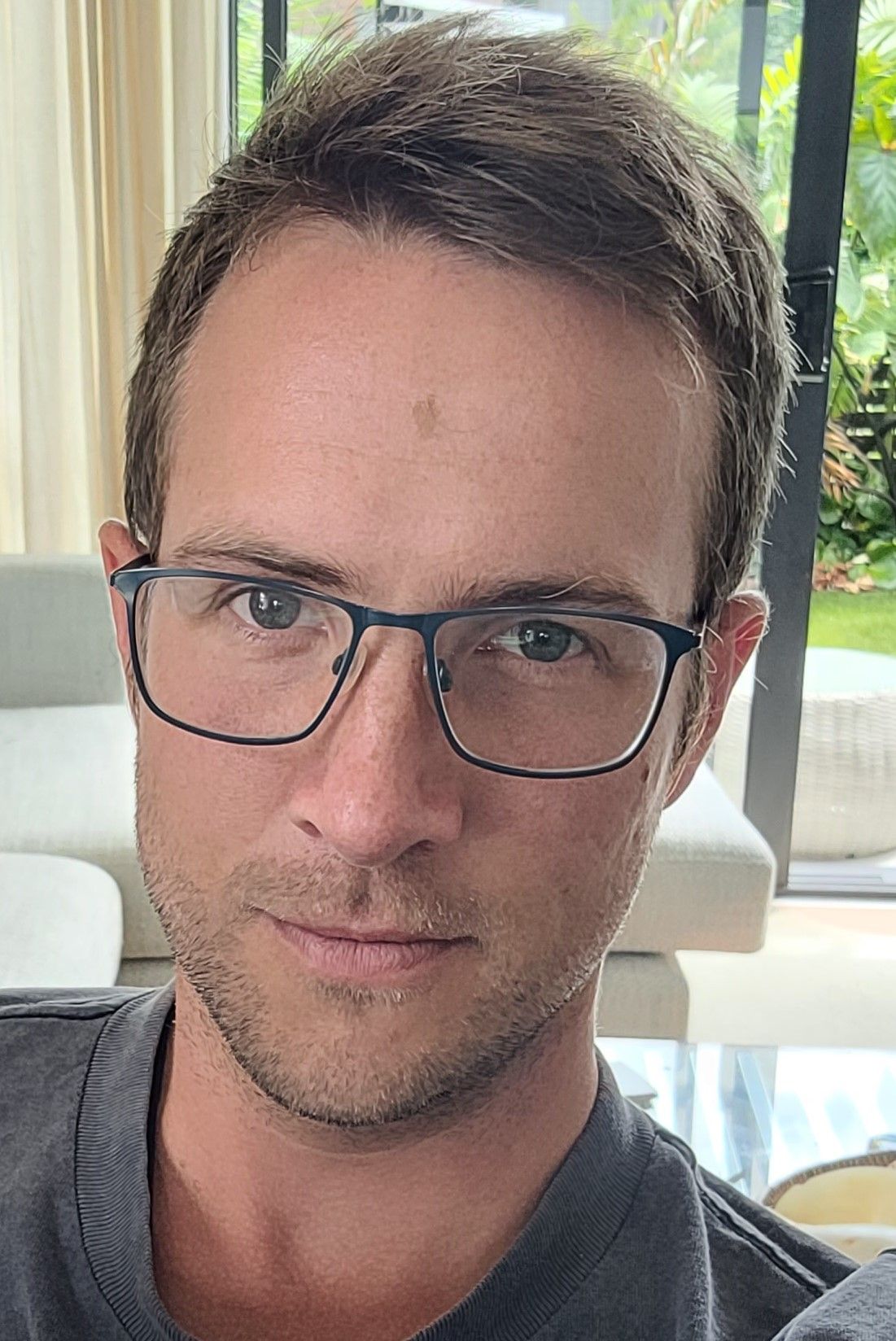
I am Dr. Kevin Tran, a Doctor of Pharmacy and an APOE4/4 carrier. Two copies of the highest-risk Alzheimer’s gene. The APOE4 gene is carried by one person out of 4.
I built Phoenix because after my diagnosis I could not find what I needed: a place where carriers track the right biomarkers, run real experiments, and stop facing this alone.
Phoenix members ran this study. They logged the data. The Neuronic LIGHT was the intervention we put to the test. Neuronic brought the device and the cognitive testing. We brought the carriers, the platform, and the honest read.
What we actually did
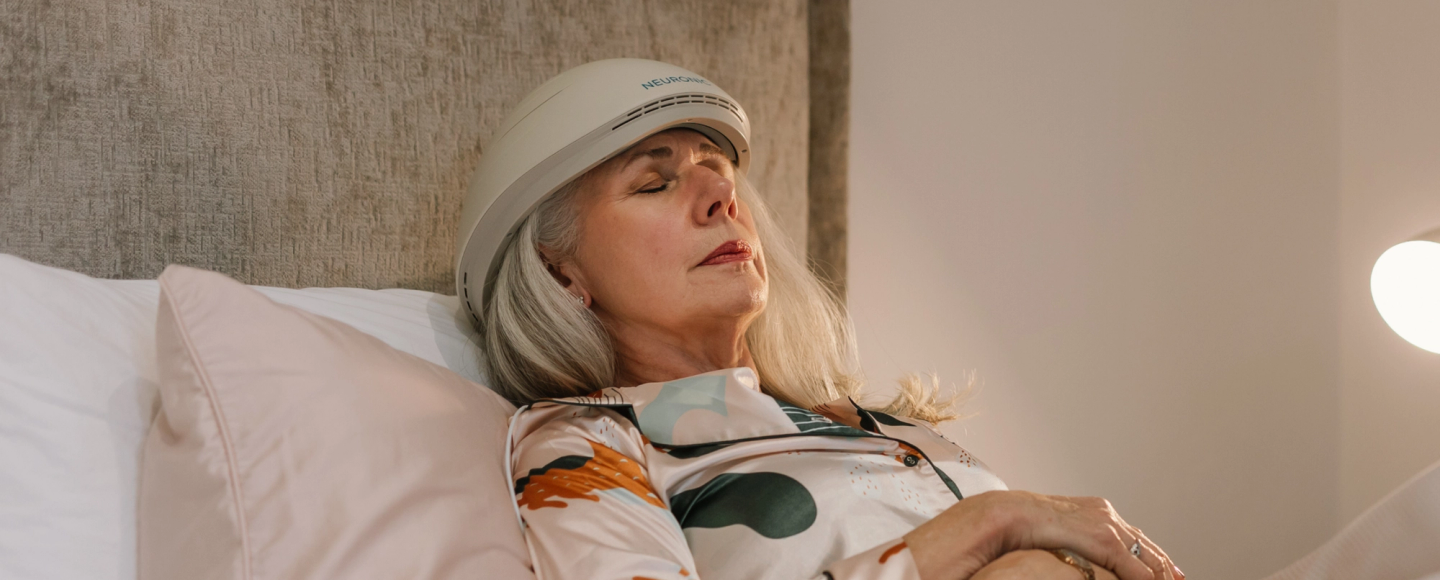
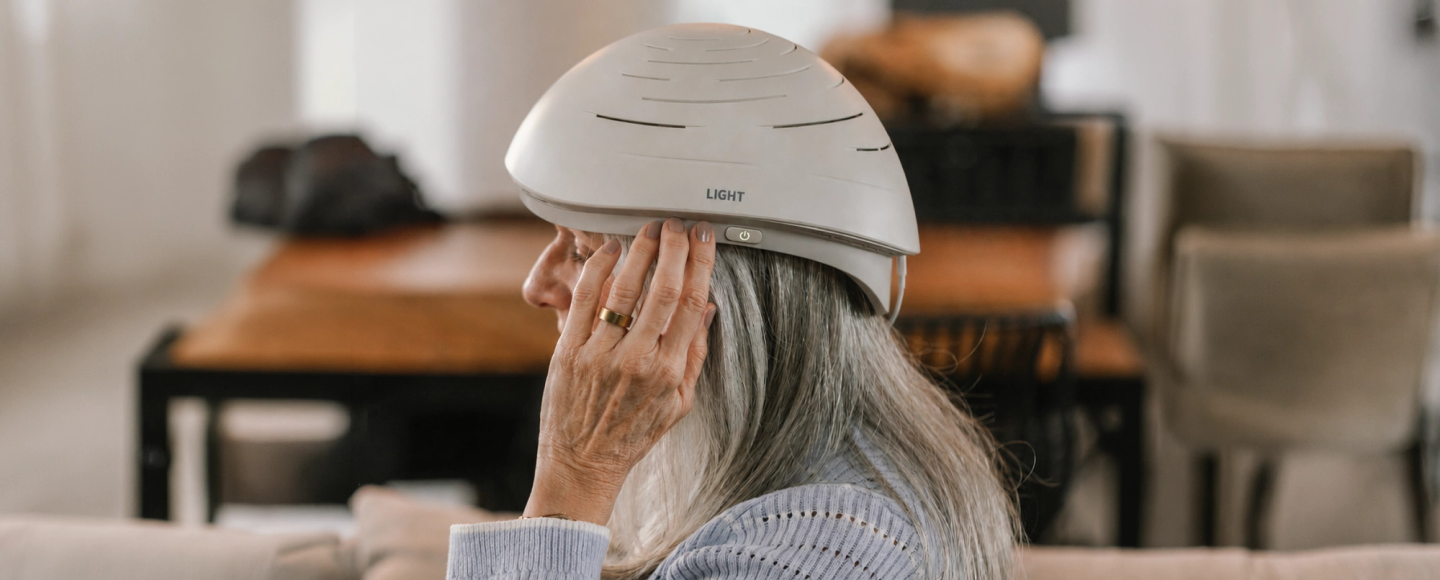
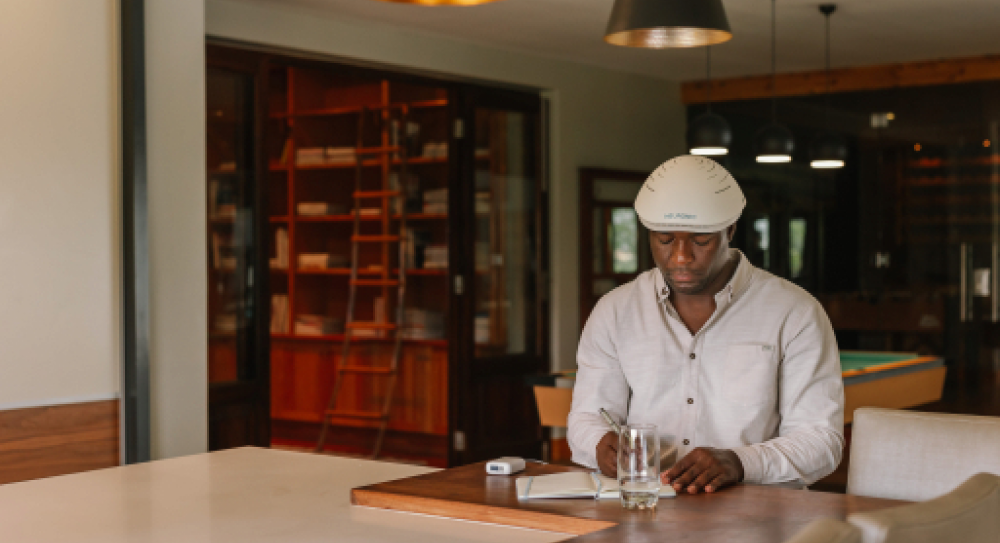
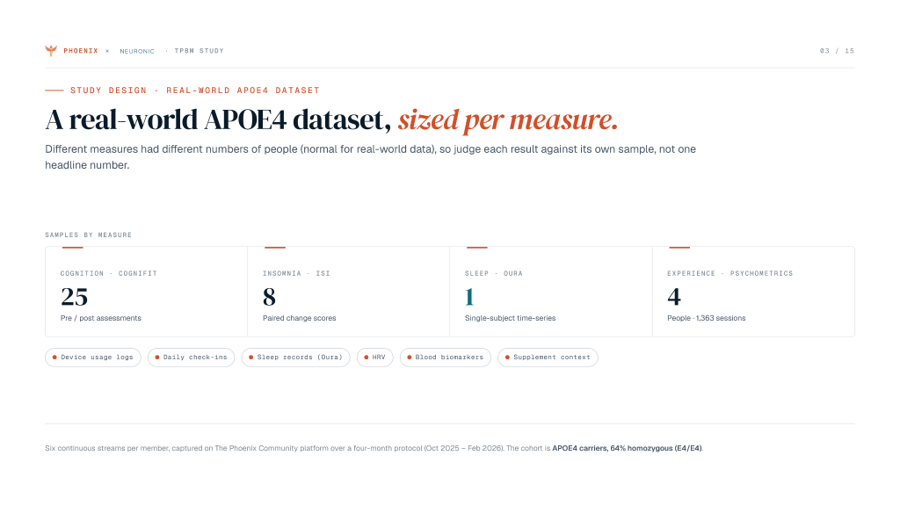
Over four months (October 2025 to February 2026), a group of APOE4 carriers added one thing to their routine: daily sessions with the Neuronic LIGHT.
Then we measured everything around it. Six continuous data streams per person: cognitive testing, sleep from Oura rings, blood biomarkers, heart-rate variability, daily check-ins, and device-usage logs. All captured inside one platform.
The cohort was high-risk on purpose. Every participant carried APOE4. 64% were homozygous E4/E4, the highest genetic risk there is. These are exactly the people most prevention research never reaches.
One honest note up front. This was the real world, so different measures had different numbers of people. Judge each result against its own sample, not one headline number. I will give you the sample every time.
How to read this honestly
Before the results, a promise: you get the honest version, not the marketing version.
The study was small, and that matters. A small study can only reliably catch big changes. So when a result just misses the cutoff, it is usually real, just hard for a small study to confirm. Keep that in mind.
Three labels, that is all you need:
- Significant (p < .05): strong, trust it.
- Near-significant (p = .05 to .11): likely real, limited by sample size.
- Stable: no meaningful change.
The headline: memory moved
Of the five thinking skills we tested, one stood out. And it is the one that matters most for us.
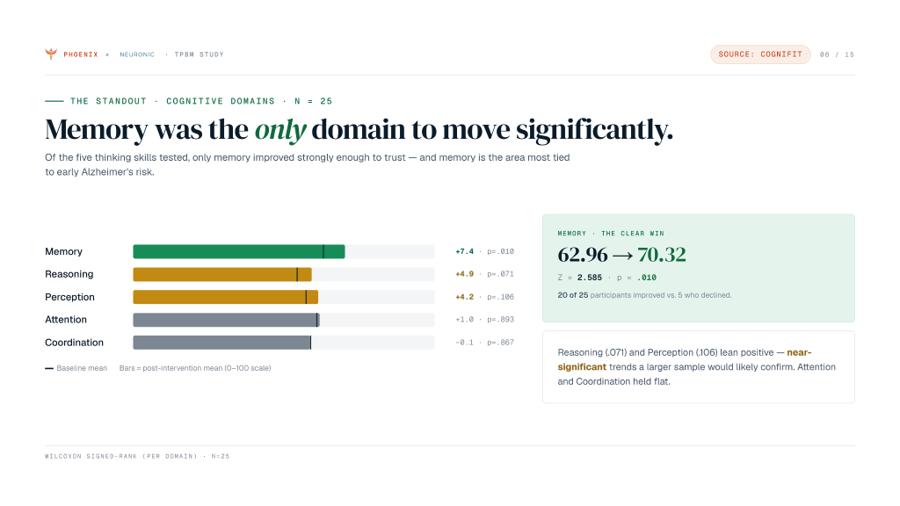
Memory improved significantly. 20 of the 25 participants got better at it. The group’s memory score climbed from 62.96 to 70.32 (for the stats-minded, Z = 2.585, p = .010).
Of everything we could have hoped to move in APOE4 carriers, memory is the bullseye. It is the domain most tied to early Alzheimer’s risk. Reasoning (p = .071) and perception (p = .106) leaned positive too, just short of the line. Attention and coordination held flat.
The wins were not random
Here is the part that made me trust it.
Out of 22 individual skills we tested, four passed the strict statistical bar on their own: naming, non-verbal memory, visual perception, and working memory. Five more were promising and near-significant.
Look at where they cluster: memory, naming, perception. The exact areas tied to early Alzheimer’s risk. Not scattered across random skills. That is what a real effect looks like, not chance.
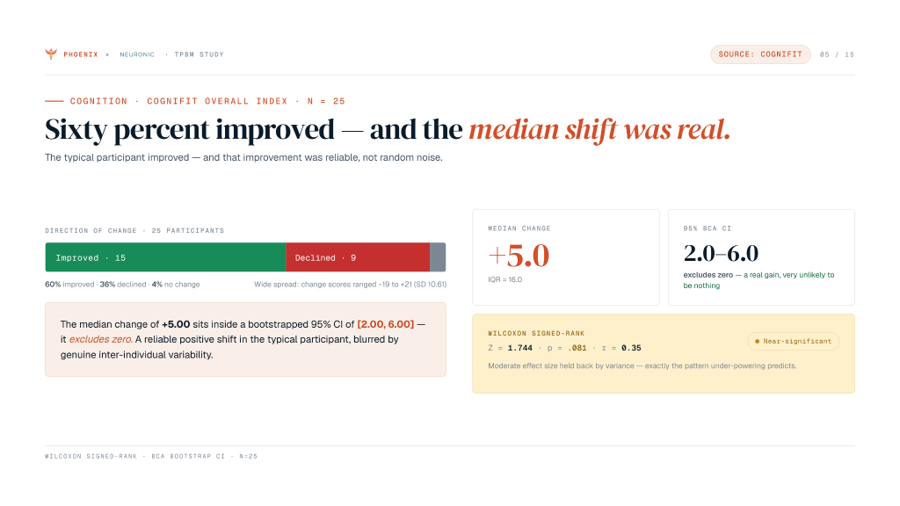
Zoom out to overall cognition and the picture holds. 60% of participants improved. The typical gain was real, not statistical noise. The median change was +5.0, and the confidence interval ([2.0, 6.0]) excluded zero.
Was it uniform? No. Scores ranged from -19 to +21. Some improved a lot. A few declined. That is real life and real biology. But the center of gravity moved the right way.
On session nights, sleep got better
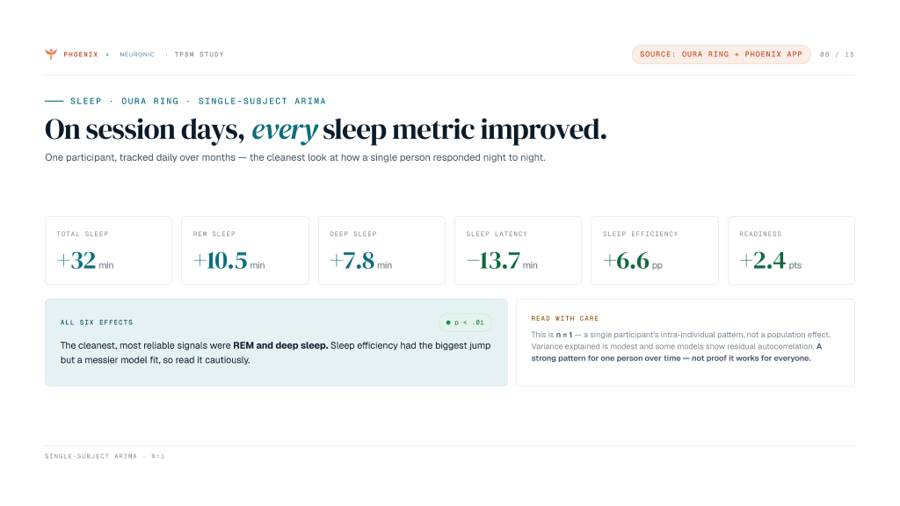
One participant tracked sleep with an Oura ring, night after night, for months. The cleanest possible look at how one person responds.
On the nights they ran a session, every single sleep metric improved:
- +32 minutes of total sleep
- +10.5 minutes of REM
- +7.8 minutes of deep sleep
- 13.7 fewer minutes to fall asleep
- +6.6 points of sleep efficiency
- +2.4 points of next-day readiness
All of it is statistically solid (p < .01). The cleanest signals were REM and deep sleep.
One honest caveat: that is one person, tracked deeply (n = 1). A strong pattern for them over months, not yet proof for everyone.
And it built the way a real effect does. The benefits did not spike on day one like a placebo. Daily readiness lifted by week 2 (+6.5 points). Total sleep time climbed by week 4 (+47 minutes), then strengthened. Effects that grow over weeks are the pattern you would expect from a real biological response. We cannot rule out a placebo effect from a single tracked person, and we are not going to pretend otherwise.
A coherent story started to form
Insomnia symptoms eased too. On the standard index (lower means fewer symptoms), the typical participant dropped 2.5 points.
Here is what gives it weight: better sleep architecture (Oura), fewer insomnia symptoms (ISI), and memory gains (cognitive testing) all leaned the same direction, in the same cohort. When independent measures agree, you start to believe the signal.
And people felt good for four straight months. Across four members’ daily self-ratings (1,363 sessions in all), sleep quality and mental sharpness trended up. Mood, energy, and overall wellbeing stayed high and steady the entire time.
That sounds modest. It is not. Those usually drift down over four months of effort and tracking fatigue. Holding them high and flat is itself a win.
The one flag, in the name of honesty: self-reported stress crept up. Could be the device, could be life, could be the act of measuring yourself daily. We are watching it, not hiding it.
Two results that made us sit up
A couple of participants shared personal results outside the formal dataset. No control group, so we treat these as stories, not proof. But they are striking.
One person’s IL-6, a key inflammation marker, fell more than 75% over about three months (6.1 to under 1.4 pg/mL).
Another improved by 5.7 points on the ADAS-Cog13, a standard Alzheimer’s cognitive assessment where lower is better (19 to 13.3).
Individual stories. But the kind that are hard to ignore.
Where it fell short
I will not oversell this. Here is what held the study back. It was small and under-powered. There was no placebo or sham group. The strongest sleep data is from one person. Follow-up was short. We did not systematically capture life stress. And repeat cognitive testing can lift scores on its own.
So this is not absolute proof. It is a real, encouraging signal. Strong enough to act on, honest enough to keep watching.
That honesty is the point. APOE4 carriers have been promised certainty by people selling things their whole lives. I would rather show you the real picture and let you decide.
The part the helmet can’t give you
Stop for a second and notice how this study even exists.
No clinic. No research coordinator with a clipboard. The cognitive scores, the sleep data, the bloodwork, the daily check-ins, all of it came from carriers quietly tracking their own lives inside one platform. That is the engine. It is the reason a study like this could happen at all.
That platform is Phoenix. Built by an APOE4/4 carrier, for APOE4 carriers. We track 27 biomarkers against APOE4-specific targets, not generic "normal." Members run structured experiments on themselves. They get matched into small monthly pods of carriers who keep each other consistent. 89% report biomarker improvements within six months. And 32% of the community are healthcare professionals, which keeps the bar high.
You already own a Neuronic LIGHT, or you are thinking about one. So here is the honest advice: a device is only as good as the baseline you measure it against. Run it like an experiment. Track a clean baseline, give it weeks not days, and let your data decide if it stays. That is the difference between hoping something works and knowing.
You carry the same risk I do. You do not have to carry it alone.
This is a movement, not a startup. Come build it with us.
Kevin
Dr. Kevin Tran
Doctor of Pharmacy and APOE4/4 carrier
Founder, The Phoenix Community
- Education, not medical advice. Findings are observational, single-cohort, partly single-subject (n = 1), with no control group, and are not proof of efficacy. The Neuronic Light is not intended to diagnose, treat, cure, or prevent any disease. Consult your physician before starting any device or protocol. Phoenix and Neuronic have a partnership and may earn affiliate fees on referrals. This does not influence the study data or our read of it.
Get Your Custom PBM Integration Strategy – Built for Clinicians and Other Professionals
In 15 minutes, you’ll walk away with a clear plan to implement PBM safely, compliantly, and without disrupting client care.
Or Give us a Call: +1 (209) 268-7839