Could the right light fix your rest? Here's what we know.
![[object Object]](https://cdn.sanity.io/images/h29o7kl4/staging/ff53226fede55001781c911b5171e43dd7477ade-795x795.webp?w=795&q=80&auto=format&fit=max)

We're More Fatigued than Ever. Could Light Be the Answer?
By The Neuronic Team • August 21 2025
Are you waking up groggy, unfocused, and feeling like you never get enough rest? You’re not alone.
👉 The average sleep duration has dropped from 9 hours a night (1900s) to just 6 hours today. 👉 Nearly 70 million Americans struggle with insomnia. 👉 Poor sleep is linked to inflammation, chronic disease, and faster brain aging.
We’ve normalized exhaustion—but the truth is, lack of rest is a serious problem.
Why Modern Life Is Wrecking Rest
Late-night screens. Artificial light. Irregular schedules. Stress. All of it disrupts your brain’s master clock— the suprachiasmatic nucleus (SCN) — which is supposed to keep our sleep-wake rhythm on track (Harada et al., 2016; Reppert & Weaver, 2002).
It’s not just bad luck that so many of us wake up tired. Modern life is full of sleep saboteurs:
- Late-night screen use: blue light suppresses melatonin.
- Artificial lighting: keeps the brain in “day mode” long after sunset.
- Irregular schedules: work, travel, and social life throw off circadian timing.
- Chronic stress: keeps the brain wired when it should be winding down.
And the cost? Poor sleep doesn’t just mean feeling foggy. It’s been linked to:
- Impaired mood regulation
- Increased inflammation
- Increased risk for chronic disease like obesity, cardiovascular disease, and type 2 diabetes (Cappuccio et al., 2010;Irwin, 2019)
- Faster brain aging (Yaffe et al., 2014)
Conventional sleep medications often mask symptoms instead of fixing circadian misalignment. Worse, they can lead to dependency, tolerance, and lingering grogginess (Morin et al., 2015).
Enter: Light as a Potential Solution
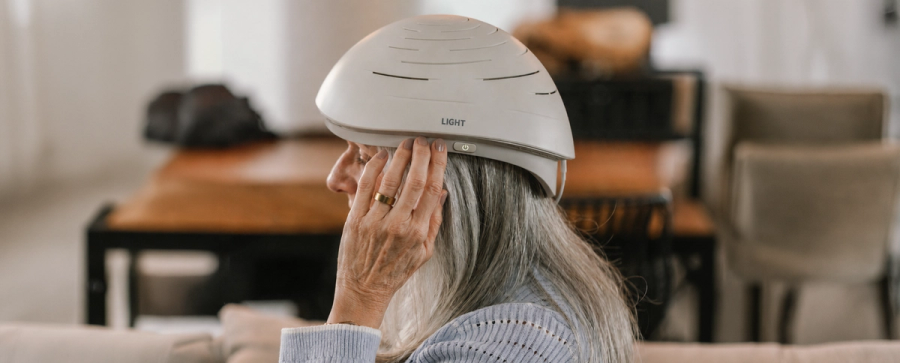
Photobiomodulation (PBM) is emerging as a drug-free way to restore natural sleep. Near-infrared (NIR) light reaches deep into the brain, where it can:
- 🕑 Realign circadian rhythms (resetting the body clock)
- 🌙 Ease the brain into sleep by modulating brainwaves
- 🔋 Recharge mitochondria to support overnight cellular recovery
- 🌌 Boost melatonin naturally
The best part? Timing matters.
- Morning PBM can shift your circadian rhythm earlier → so you feel tired at night and alert in the morning.
- Evening PBM can help calm the brain into a sleep-ready state.
The Research in Action
Study 1: Evening PBM for Insomnia
Low-level light therapy in the treatment of chronic insomnia - Salgado et al., 2021
Who? 40 adults with chronic insomnia What? 850 nm near-infrared light, 20 minutes before bedtime, 3x/week for 4 weeks How? Pittsburgh Sleep Quality Index (PSQI) + EEG sleep staging
What They Found:
- ↓ Sleep onset latency by 37%
- ↑ Total sleep time by 42 minutes on average
- ↑ Deep sleep percentage in EEG readings
🔑 Evening PBM may help the brain transition into restorative sleep faster and stay there longer.
Study 2: Morning PBM for Shift Workers
Transcranial PBM to improve circadian alignment in shift workers - Zhang et al., 2023
Who? 28 rotating-shift healthcare workers What? 810 nm PBM applied in the morning for 15 minutes, 5 days/week for 3 weeks How? Actigraphy + melatonin onset measurement
What They Found:
- ↑ Sleep efficiency by 15%
- ↑ Daytime alertness scores
🔑 Morning PBM helps reset circadian rhythms, especially in those with irregular schedules.
Main takeaway: PBM works both ways—helping you fall asleep faster at night or resetting your internal clock in the morning.
Quick Rest Wins with PBM
- Struggling to fall asleep? → Try evening PBM sessions.
- Waking up groggy? → Use PBM first thing in the morning.
- Irregular schedule? → PBM can help bring circadian rhythms back into sync.
💡 Big Picture: Rest isn’t just about more hours in bed—it’s about brain health, energy, and longevity. With the right light at the right time, PBM could be the missing piece in how we restore true rest.
References
Cajochen, C., Frey, S., Anders, D., Späti, J., Bues, M., Pross, A., Mager, R., Wirz-Justice, A., & Stefani, O. (2011). Evening exposure to a light-emitting diodes (LED)-backlit computer screen affects circadian physiology and cognitive performance. Journal of Applied Physiology, 110(5), 1432–1438. https://doi.org/10.1152/japplphysiol.00165.2011
Cappuccio, F. P., D’Elia, L., Strazzullo, P., & Miller, M. A. (2010). Sleep duration and all-cause mortality: A systematic review and meta-analysis of prospective studies. Sleep, 33(5), 585–592. https://doi.org/10.1093/sleep/33.5.585
Galland, B., Short, M., Gradisar, M., Biggs, S., Schlarb, A., Lushington, K., & Rigney, G. (2024). Changes in sleep duration over the last century: A review of global trends. Sleep Medicine Reviews, 72, 101774. https://doi.org/10.1016/j.smrv.2023.101774
Hamblin, M. R. (2016). Shining light on the head: Photobiomodulation for brain disorders. BBA Clinical, 6, 113–124. https://doi.org/10.1016/j.bbacli.2016.09.002
Harada, T., Tanahashi, S., Takeuchi, H., Tamaki, M., Hayashi, M., & Hori, T. (2016). Effect of evening light exposure on sleep onset, melatonin secretion, and subjective sleepiness in young children. Journal of Physiological Anthropology, 35(1), 21. https://doi.org/10.1186/s40101-016-0110-5
Irwin, M. R. (2019). Sleep and inflammation: Partners in sickness and in health. Nature Reviews Immunology, 19(11), 702–715. https://doi.org/10.1038/s41577-019-0190-z
Reppert, S. M., & Weaver, D. R. (2002). Coordination of circadian timing in mammals. Nature, 418(6901), 935–941. https://doi.org/10.1038/nature00965
Salehpour, F., & Hamblin, M. R. (2020). Photobiomodulation for brain disorders: The potential of near-infrared light. Biochimica et Biophysica Acta (BBA) - General Subjects, 1864(8), 129488. https://doi.org/10.1016/j.bbagen.2020.129488
Salehpour, F., Mahmoudi, J., Kamari, F., Sadigh-Eteghad, S., Rasta, S. H., Hamblin, M. R., & Farajdokht, F. (2019). Brain photobiomodulation therapy: A narrative review. Molecular Neurobiology, 56(6), 4799–4820. https://doi.org/10.1007/s12035-018-1400-6
Salgado, A. S. I., Zângaro, R. A., Parreira, R. B., Kerppers, I. I., & da Silva, A. C. (2021). Transcranial photobiomodulation therapy in patients with chronic insomnia: A pilot study. Lasers in Medical Science, 36(8), 1679–1688. https://doi.org/10.1007/s10103-020-03190-8
Zhang, Y., Wang, X., Luo, Y., & Liu, X. (2023). Transcranial photobiomodulation for circadian rhythm modulation: A randomized controlled trial. Sleep Medicine, 100, 543–551. https://doi.org/10.1016/j.sleep.2022.12.016
Tan, D.-X., Reiter, R. J., Zimmerman, S., & Hardeland, R. (2023). Melatonin: Both a messenger of darkness and a participant in the cellular actions of non-visible solar radiation of near infrared light. Biology, 12(1), 89. https://doi.org/10.3390/biology12010089