There's an invisible brain hazard lurking in your home (50% of houses have this)
![[object Object]](https://cdn.sanity.io/images/h29o7kl4/staging/ff53226fede55001781c911b5171e43dd7477ade-795x795.webp?w=795&q=80&auto=format&fit=max)
Have you experienced brain fog, fatigue, anxiety, or memory changes with no clear cause?
Well, hidden environmental factors could be playing a role.
Sometimes, the most profound stress on your brain doesn’t come from a concussion or stroke.
It comes from chronic, invisible exposure that is often misdiagnosed or dismissed. One of the most under-recognized of these is mold and the mycotoxins it produces.
You might notice:
- Brain fog or memory issues
- Anxiety or low mood
- Poor sleep or exhaustion
- Nervous system symptoms like dizziness or poor stress tolerance
You're not alone.
It's a widespread neurological health problem and one that often goes undetected until cognitive, emotional, and autonomic symptoms become impossible to ignore.
Children are especially vulnerable because their brains are still developing.
Today, we're going to dig into why hidden exposures create real neurological injury and how tPBM may support recovery.
What makes mold especially dangerous is not just the organism, but the mycotoxins it produces.
Symptoms rarely appear all at once. Instead, you or your family might notice:
- Different symptoms in different people
- Gradual cognitive, behavioral and mood changes
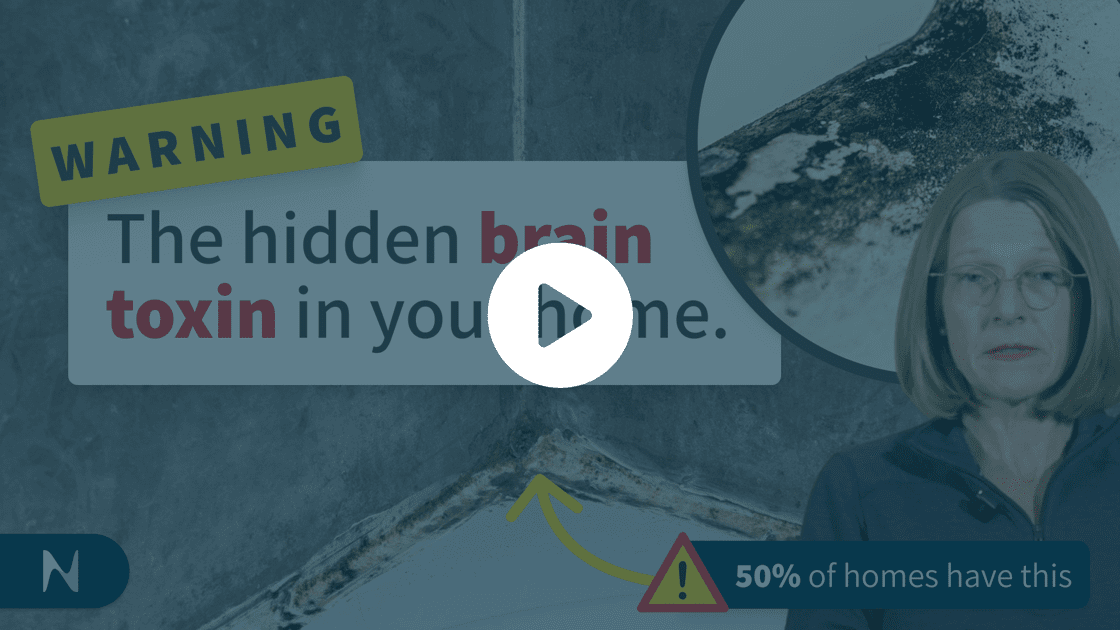
We recently released a video with the personal story of one of our team members, Brooke Hill, who explains how mold impacts the brain, and how light therapy may support neurological recovery.
What makes mold especially dangerous is not just the organism, but the mycotoxins it produces.
Symptoms rarely appear all at once. Instead, you or your family might notice:
- Different symptoms in different people
- Gradual cognitive, behavioral and mood changes
Mold vs. mycotoxins
Mold exposure is often dismissed as an allergy issue, but many mold species produce potent neurotoxic mycotoxins, including ochratoxin A, trichothecenes, gliotoxin, aflatoxins and fumonisins (1).
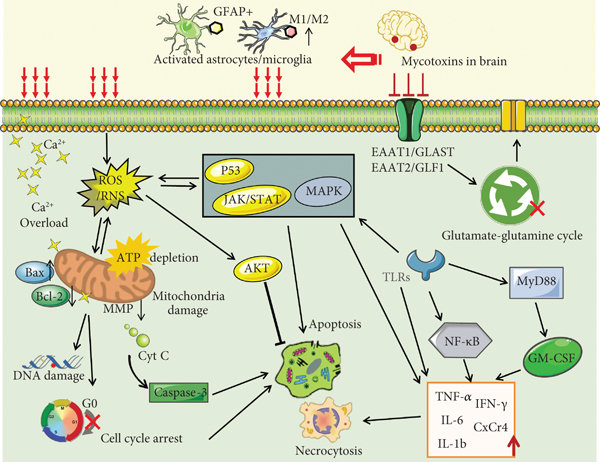
Molecular mechanisms of mycotoxin-induced neurotoxicity in neuroglia cellsWhy mycotoxins are uniquely harmful to the brain:
1. They cross the blood–brain barrier
Many mycotoxins are fat soluble, allowing them to cross the blood–brain barrier, the protective wall around your brain (2).
Importantly, gut permeability and brain permeability are strongly correlated, meaning a leaky gut often signals a vulnerable brain barrier (3).
2. Switches on brain inflammation
Once inside the brain, mycotoxins activate microglia, the brain's immune cells, triggering a release of inflammatory cytokines.
This persistent neuroinflammatory state can lead to brain fog, anxiety, depression, cognitive slowing and increased neurodegenerative risk (4).
3. Mitochondrial dysfunction
Ochratoxin A disrupts ATP production, depriving neurons of energy. Low neuronal energy manifests as fatigue, memory impairment and reduced processing speed (5).
4. Oxidative stress & emotional instability
Mycotoxins increase reactive oxygen species and can overstimulate glutamate, contributing to neuronal injury and emotional volatility (6).
5. Neurotransmitter disruption
Alterations in dopamine, serotonin and acetylcholine signaling contribute to mood disorders, attention deficits and executive dysfunction (7).
6. Changes in brain structure & blood flow
Neuroimaging studies demonstrate volume loss and altered blood flow in regions responsible for memory, mood and executive function (8).
tPBM supports the mold-injured brain
Transcranial photobiomodulation (tPBM) is a modality that supports the recovery journey from mold related illness. tPBM has demonstrated the ability to:
- Enhance mitochondrial ATP production via cytochrome-c oxidase activation (12).
- Reduce microglial activation and inflammatory cytokines (13).
- Improve cerebral blood flow and oxygenation (14).
- Support neuroplasticity and limbic network regulation (15).
In mold related illness, tPBM does not replace remediation or detoxification, but may support neuronal energy recovery, inflammation reduction and cognitive-emotional regulation.
The gut–brain axis & mold
Mold illness is never “just in the brain.”
Mold exposure releases toxins that decrease hormones like MSH and ADH. This results in disrupted sleep, dehydration, poor immunity and gut dysbiosis (9).
Notably, penicillin itself is derived from a Penicillium mycotoxin, illustrating how chronic exposure can resemble daily low-dose antibiotic exposure, driving dysbiosis and systemic inflammation (10).
Can we see mold injury in the brain?
Yes. Advanced neuroimaging tools such as NeuroQuant and NeuroReader MRI reveal distinct structural and volumetric patterns in mold-exposed individuals.
Dr. Mary Ackerley has described volume loss in the brain, alongside swelling in the insula and hippocampus, consistent with biotoxin-driven neuroinflammation (11).
Brain MRI scan being processed with NeuroQuant software, highlighting how the technology visualizes and quantifies different brain structures
Key Takeaway
Chronic mycotoxin exposure has been linked to cognitive impairment, anxiety, depression, autonomic dysfunction, and increased neurodegenerative risk.
These symptoms are driven by measurable biological changes, including neuroinflammation, mitochondrial dysfunction, and disrupted brain network regulation, not simply psychological causes.
Transcranial photobiomodulation (tPBM) may help support neural recovery by improving cellular energy, reducing inflammation, and supporting brain function alongside proper remediation.
References
- Bennett, J. W., & Klich, M. (2003). Mycotoxins. Clinical Microbiology Reviews.
- Maresca, M. (2013). From the gut to the brain: Journey and pathophysiological effects of the food-associated trichothecene mycotoxin deoxynivalenol. Toxins.
- Obrenovich, M. E. (2018). Leaky gut, leaky brain? Neuropsychiatric Disease and Treatment.
- Pei, X., Zhang, W., Jiang, H., Liu, D., Liu, X., Li, L., Li, C., Xiao, X., Tang, S., & Li, D. (2021). Food-origin mycotoxin-induced neurotoxicity: mechanisms of neuroglia cell damage including ROS accumulation and glutamate clearance inhibition. Oxidative Medicine and Cellular Longevity.
- Ringot, D., Chango, A., Schneider, Y.-J., & Larondelle, Y. (2006). Toxicokinetics and toxicodynamics of ochratoxin A: an update. Chemico-Biological Interactions.
- Pei, X., et al. (2021). Food-origin mycotoxin-induced neurotoxicity: mechanisms of neuroglia cell damage including ROS accumulation and glutamate clearance inhibition. Food and Chemical Toxicology.
- Islam, Z., Harkema, J. R., & Pestka, J. J. (2006). Satratoxin G from the black mold Stachybotrys chartarum evokes olfactory sensory neuron loss and inflammation in the murine nose and brain. Environmental Health Perspectives.
- Shoemaker, R. C., House, D., & Ryan, J. C. (2014). Structural brain abnormalities in patients with inflammatory illness acquired following exposure to water-damaged buildings: A volumetric MRI study using NeuroQuant. Neurotoxicology and Teratology.
- Shoemaker, R. C., & House, D. (2005). A time-series study of sick building syndrome: chronic, biotoxin-associated illness from exposure to water-damaged buildings. Neurotoxicology and Teratology.
- Cryan, J. F., & Dinan, T. G. (2012). Mind-altering microorganisms: The impact of the gut microbiota on brain and behaviour. Nature Reviews Neuroscience.
- Shoemaker, R. C., House, D. E., & Ryan, J. C. (2014). Structural brain abnormalities in patients with inflammatory illness acquired following exposure to water-damaged buildings: A volumetric MRI study using NeuroQuant.
- Salehpour F., et al. (2018). Brain Photobiomodulation Therapy: A Narrative Review. Photomedicine and Laser Surgery.
- Cardoso et al 2022. Photobiomodulation for the treatment of neuroinflammation: A systematic review of controlled laboratory animal studies. Journal of Neuroinflammation.
- Hamblin, M. R. (2017). Mechanisms and applications of the anti-inflammatory effects of photobiomodulation. AIMS Biophysics.
- Montazeri K., Chaibakhsh S., & Fekrazad R. (2025). Effects of transcranial photobiomodulation in cerebral circulation and brain neural oscillations: A systematic review. Lasers in Medical Science.

Subscribe for insights, tips, offers & more.
By signing up, you accept our privacy policy. Your personal data will be processed so that we can contact you about our products. Read our Privacy Policy for more information.