Is Light the ADHD Hack No One’s Talking About?
![[object Object]](https://cdn.sanity.io/images/h29o7kl4/staging/ff53226fede55001781c911b5171e43dd7477ade-795x795.webp?w=795&q=80&auto=format&fit=max)

Is Light the ADHD Hack No One’s Talking About?
By Sarah Doheny & Neuronic • 9th October 2025
You sit down to start a task, but your brain leaps - emails, messages, half-finished tasks pulling you everywhere at once. Is this just a distraction, or could it be ADHD?
It’s everywhere, the National Survey of Children's Health estimates that nearly 1 in 10 children in the U.S. have been diagnosed with ADHD, and many more go undiagnosed.
October is ADHD awareness month, and with such a high prevalence in 2025, it’s a condition that deserves more attention and understanding.
In this edition, we'll explore:
- What is ADHD and how does it impact the brain?
- The latest insights on its prevalence & persistence
- Transcranial photobiomodulation’s (tPBM) potential to support ADHD brain function
I's More than Poor Focus. Here’s What ADHD Really Is:
ADHD (Attention-Deficit Hyperactivity Disorder) is a neurodevelopmental condition marked by inattention, hyperactivity and impulsivity.
ADHD often begins in childhood and for many continues into adulthood, shaping how those affected learn, work and connect with others. It doesn’t just touch one part of life, it weaves into the everyday, affecting school struggles, workplace challenges and relationships with family and friends.
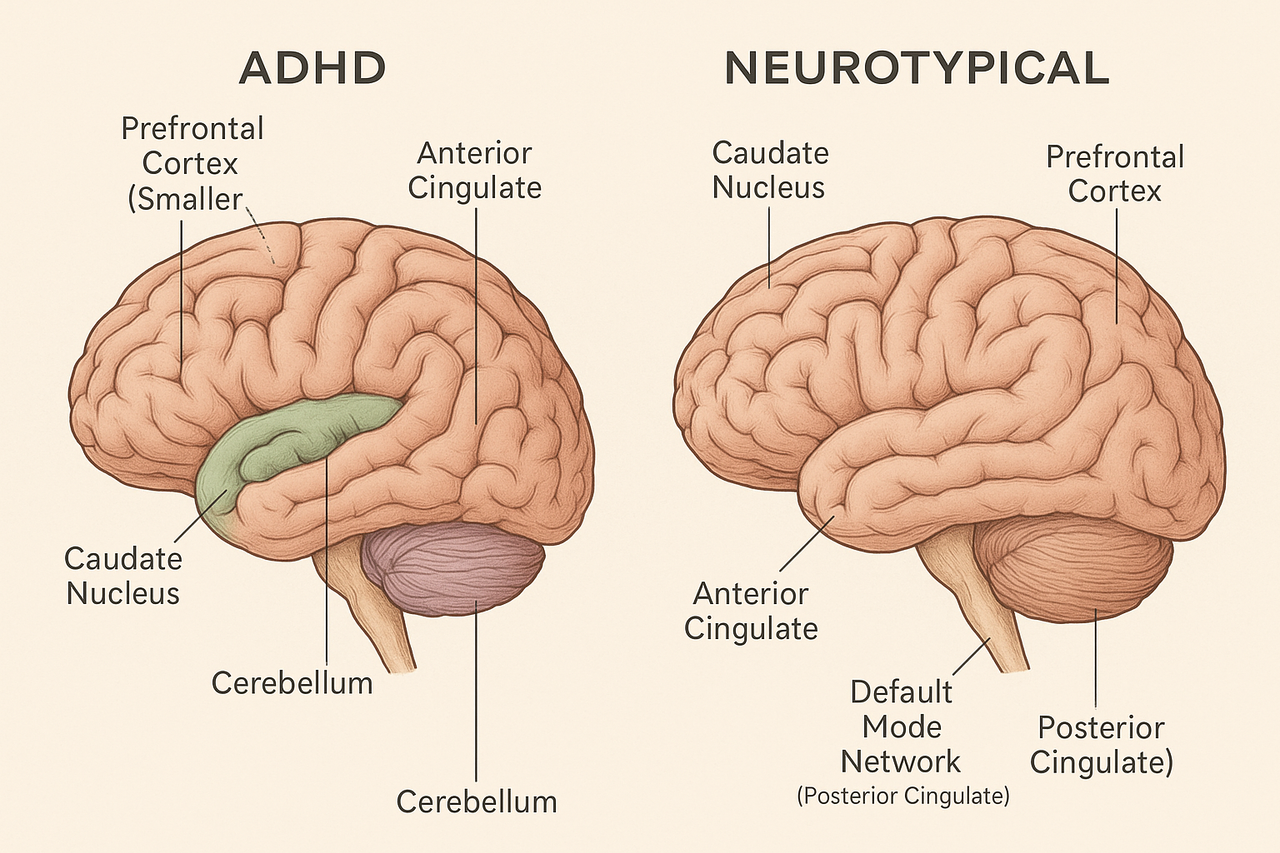
At the brain level, these symptoms reflect differences in the networks that govern executive function, impulse control and attention. Particularly in the prefrontal cortex, the region responsible for planning, decision-making and regulating behavior, and its connections with deeper regions like the striatum.
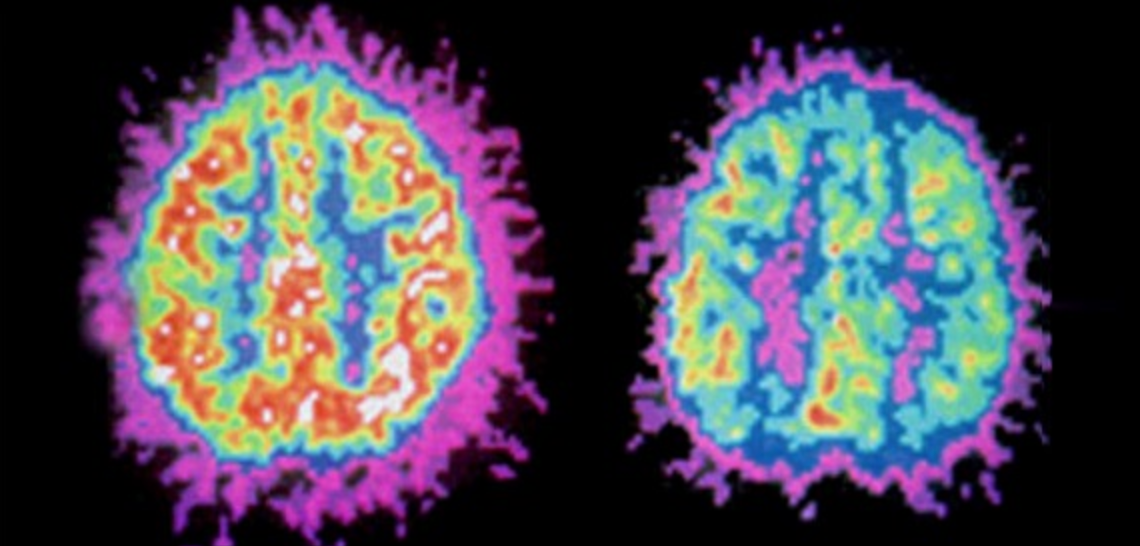
Put simply, the prefrontal cortex is like the planner and regulator, while the striatum is like the motivator and reward-seeker. When their communication is off balance, it can contribute to the challenges seen in ADHD. A PET scan can illustrate the difference between a brain with ADHD (left) and one without (right).
Facts About ADHD
- Global prevalence of ADHD in children and adolescents is about 8.0% of the population, with boys being roughly twice as likely as girls to be diagnosed (1).
- The prevalence of ADHD in the US is slightly higher with 11% of children diagnosed (2).
- It's estimated that over 15 million adults in the US live with ADHD, and many face barriers to treatment (3).
The Toll of Untreated ADHD
When ADHD goes untreated, the impact can be deeply personal, creating tension in relationships, challenges in the workplace and sometimes a sense of falling short of one’s true potential.
Over time, this can take a heavy toll on overall wellbeing and quality of life and may lead to higher risk for substance use, accidents and mental health challenges (4). A UK study found adults with ADHD may live 7 years less for men and 8.6 years less for women, largely due to comorbidities and healthcare access issues (5).
What We Know About tPBM and ADHD
Current treatments primarily involve a focus on pharmacological and behavioral interventions. However, concerns regarding the potential side effects, long-term safety and limited efficacy of such interventions in specific populations indicate a need for alternative treatment modalities.
tPBM uses targeted near-infrared light to stimulate brain processes and relieve symptoms, offering a non-drug approach. A review of neurodevelopmental disorders, including ADHD, found tPBM improved attention and cognitive function with minimal adverse effects (6). Case studies in adults report improved focus, organization, and management of ADHD symptoms following tPBM (7).
3 Ways tPBM Supports People with ADHD
- Boost Attention & Executive Function Light may enhance activity in frontal brain regions tied to focus and self-regulation, improving task performance and behavioral control.
- Rebalance Brain Energy & Chemistry By supporting mitochondrial ATP production and reducing oxidative stress, tPBM may help neurons function more effectively, key for attention and impulse control.
- Promote a Healthier Neural Environment Through reduced neuroinflammation, improved blood flow, and support of neuronal connectivity, tPBM may enhance neural plasticity and resilience.
Study Highlight: 21-Day PBM Treatment in ADHD Model Rats
‘Photobiomodulation as a Therapeutic Approach for Attention-Deficit/Hyperactivity Disorder in Model Rats’ (8)
- Reduced impulsivity by lowering inflammation in key brain regions (prefrontal cortex, striatum, hippocampus).
- Preserved brain health, supporting cellular integrity, synaptic plasticity, and neuronal connectivity.
- Balanced brain chemistry, improving dopamine and norepinephrine signaling while reducing oxidative stress—two major factors linked to ADHD symptoms.
🔑 Takeaway: This preclinical study suggests PBM may directly target the biological roots of ADHD, improving both brain structure and function.
Reimagining ADHD Support
Traditional ADHD treatments target symptoms, on the other hand tPBM offers a complementary, non-invasive therapy aimed at network-level cellular brain health. By enhancing energy, circulation and synaptic function, tPBM may pave the way for improved executive control and daily functioning, ultimately leading to improved symptoms and quality of life. As ADHD remains widespread and impactful, emerging therapies like light therapy provide new avenues of care, highlighting the importance of continued research and innovation.
References
Ayano G, Demelash S, Gizachew Y, Tsegay L, Alati R. The global prevalence of attention deficit hyperactivity disorder in children and adolescents: An umbrella review of meta-analyses. J Affect Disord [Internet]. 2023 Oct 15 [cited 2025 Sep 22];339:860–6. Available from: https://pubmed.ncbi.nlm.nih.gov/37495084/
Data and Statistics on ADHD | Attention-Deficit / Hyperactivity Disorder (ADHD) | CDC [Internet]. [cited 2025 Sep 22]. Available from: https://www.cdc.gov/adhd/data/index.html?utm_source
ADHD - NCHS Rapid Surveys System [Internet]. [cited 2025 Sep 22]. Available from: https://www.cdc.gov/nchs/rss/round2/ADHD.html#dashboard
Ginsberg Y, Quintero J, Anand E, Casillas M, Upadhyaya HP. Underdiagnosis of attention-deficit/hyperactivity disorder in adult patients: A review of the literature. Prim Care Companion J Clin Psychiatry. 2014;16(3).
Barkley RA, Fischer M. Hyperactive Child Syndrome and Estimated Life Expectancy at Young Adult Follow-Up: The Role of ADHD Persistence and Other Potential Predictors. J Atten Disord [Internet]. 2019 Jul 1 [cited 2025 Sep 22];23(9):907–23. Available from: /doi/pdf/10.1177/1087054718816164?download=true
Coelho DRA, Renet C, López-Rodríguez S, Cassano P, Vieira WF. Transcranial photobiomodulation for neurodevelopmental disorders: a narrative review. Photochem Photobiol Sci [Internet]. 2024 Aug 1 [cited 2025 Sep 22];23(8):1609–23. Available from: https://pubmed.ncbi.nlm.nih.gov/39009808/
Stephan W, Banas LJ, Brierley W, Hamblin MR, Stephan W, Banas LJ, et al. Efficacy of Photobiomodulation for Attention Deficit Hyperactivity Disorder (ADHD): Case Studies. World J Neurosci [Internet]. 2022 Aug 16 [cited 2025 Sep 22];12(3):136–43. Available from: https://www.scirp.org/journal/paperinformation?paperid=119187
Huang YJ, Li YT, Tsai ML, Lee FC, Niwa A, Yen CH, et al. Photobiomodulation as a Therapeutic Approach for Attention-Deficit/Hyperactivity Disorder in Model Rats. [cited 2025 Sep 22]; Available from: https://ssrn.com/abstract=5193812