

Is Light Therapy Safe for Kids?
![[object Object]](https://cdn.sanity.io/images/h29o7kl4/staging/0c0476690b5e49f9a375deb663c4d52aa39fa8e2-352x351.heif?w=352&q=80&auto=format&fit=max)
Is Light Therapy Safe for Kids? tPBM Safety Evidence for Children
When trying out a new technology on their children, the first question parents ask is, “Is this safe for my child?” The same goes for light therapy.
Research on transcranial photobiomodulation (tPBM) - non-invasive light therapy for brain health - is gaining attention for helping children with ADHD, autism, and other neurodevelopmental conditions.
The good news? Pediatric trials show tPBM is well-tolerated with no serious side effects, though long-term data continues to grow.
What Is tPBM and Why Consider It for Kids?
tPBM delivers red/near-infrared light (600-1070nm) through the scalp to boost mitochondrial energy via ATP production, reduce neuroinflammation, and enhance neural connectivity. In children, it's studied for neurodevelopmental support and attention. Unlike harmful UV light, tPBM devices use gentle LED light at carefully selected wavelengths, designed to stay within safe levels.
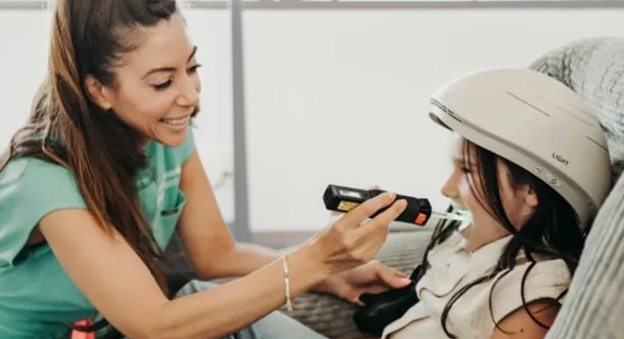
Erinn Askin’s OTEIM clinic using a Neuronic device (Image source: @neuronic on Instagram)
Key Studies: tPBM and Light Therapy Safety in Pediatric Trials
Multiple studies confirm light therapy safety in children:
These studies demonstrate low-level light therapy safety for kids, with few to zero side effects.
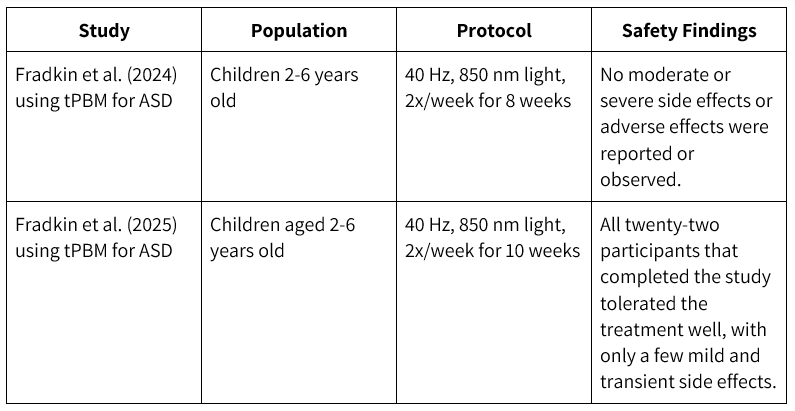
Study source: Fradkin et al. (2024) using tPBM for ASD Fradkin et al. (2025) using tPBM for ASD
Under the Microscope: How tPBM Works Safely in Developing Brains
tPBM triggers cytochrome c oxidase in mitochondria, increasing ATP that can assist with creating and protecting neurons. Light therapy can specifically help growing brains in many ways including:
- Increasing Neuroplasticity - Neuroplasticity is integral to brain development, as children grow and learn new skills. Studies show tPBM can assist in neuroplasticity through supporting brain derived neurotrophic factors (BDNF), a molecule necessary for cell survival and differentiation of new neurons (Hennessy & Hamblin, 2016).
- Reducing Inflammation - Children are exposed to various forms of neuroinflammation whether a result of diet, the common cold or something more sinister. tPBM has shown to reduce inflammation through microglial signaling, shifting microglia from a pro‑inflammatory “M1” phenotype toward an anti‑inflammatory “M2” profile. This in turn, reduces neurotoxic cytokines and enhances debris and protein clearance (Cardoso et al., 2022).
- Responding to High Metabolic Demands - Children’s rapidly developing brains have intense energy needs, driving their need for extensive sleep to support mitochondrial recovery and glymphatic clearance. tPBM boosts neuronal ATP production, helping meet these elevated metabolic demands during growth and learning.
These microbiological changes can then result in not only healthier brains, but symptom management in children with conditions like autism, ADHD, and learning disabilities. Research across varying ages shows tPBM can:
- Improve regulation of brain wave patterns in children with autism (Fradkin et al., 2024)
- Increase sustained attention and working memory in adults (Qu et al., 2022)
- Decrease noncompliant behavior in children with autism (Pallanti et al., 2022)
Common Questions About Using tPBM with Children
Does eye protection need to be worn when using tPBM?
This can depend on the device you’re using. If you are using a tPBM device that has LED placements close to the eyes or there is any chance of direct or reflected light entering the eyes, eye protection would be recommended.
What are any potential side effects?
Any side effects found in literature are typically showing a mild, transient headache as a potential side effect. In ASD studies, some parents reported hyperactivity as a side effect from the tPBM, but this usually resolved itself quickly (Fradkin et al., 2025).
What are the age limits of using tPBM?
The youngest age found in tPBM research is 2 years old, but age limits may also be determined by the fit of the device. Starting at a low dosage is especially important for younger children.
Best Practices for Using tPBM on Children
Follow these evidence-based guidelines for safe tPBM protocols for kids:
- Start Low, Go Slow: Begin with 3-5 min sessions, 2-3x/week at 25-50% intensity. Increase only if tolerated (i.e. no overstimulation). Children have thinner skin and skulls than adults so may require lower dosing. Always work with a professional or light therapy provider when determining dose.
- Ensure Proper Hydration: Be sure to drink a glass of water before and after your tPBM session to prevent dehydration.
- Timing: When starting off with tPBM, avoid using any protocols close to bedtime. As you become more familiar with your tolerance, you can use this in the evening. Also, keeping 4-5 hours between sessions is recommended.
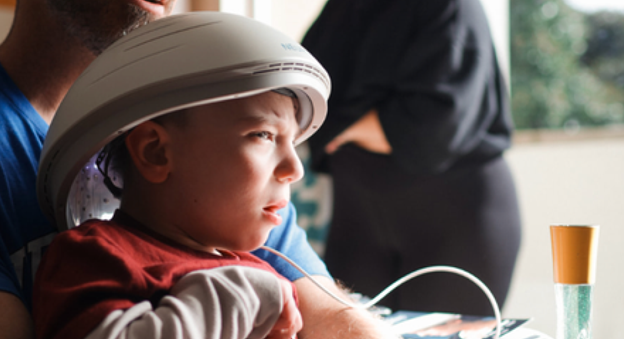
Neuronic at a Caputo Trio Foundation event
Bottom Line: tPBM Shows Strong Safety Profile for Kids
Is light therapy safe for children? Research on ASD, myopia, and neurodevelopment suggests so, with trials showing no serious adverse events, high compliance, measurable brain benefits. Always prioritize medical guidance over DIY. The future looks bright for tPBM in pediatric brain health.
*Medical Disclaimer (Photobiomodulation Therapy in Children)
The information in this blog about photobiomodulation therapy is for general education only and is not medical advice. PBM therapy in the pediatric population is still being studied. While it may have potential benefits, its safety, effectiveness, and best treatment methods are not yet fully understood for all conditions or age groups. Always talk to a qualified healthcare provider, such as a pediatrician, before starting PBM therapy for a child. Treatment decisions should be based on professional medical guidance and individual needs. This blog does not recommend any specific treatments or devices and is not responsible for any outcomes related to the use of this information.
References:
dos Santos Cardoso, F., Gonzalez-Lima, F., & Hamblin, M. R. (2022). Photobiomodulation for the treatment of neuroinflammation: A systematic review. Journal of Neuroinflammation, 19, 253. https://doi.org/10.3389/fnins.2022.1006031
Fradkin, Y., Anguera, J. A., Simon, A. J., De Taboada, L., & Steingold, E. (2025). Transcranial photobiomodulation for reducing symptoms of autism spectrum disorder and modulating brain electrophysiology in children aged 2–7: An open-label study. Frontiers in Child and Adolescent Psychiatry, 4, 1477839. https://doi.org/10.3389/frcha.2025.1477839
Fradkin, Y., De Taboada, L., Naeser, M., Saltmarche, A., Snyder, W., & Steingold, E. (2024). Transcranial photobiomodulation in children aged 2–6 years: A randomized sham-controlled clinical trial assessing safety, efficacy, and impact on autism spectrum disorder symptoms and brain electrophysiology. Frontiers in Neurology, 15, 1221193. https://doi.org/10.3389/fneur.2024.1221193
Hennessy, M., & Hamblin, M. R. (2017). Photobiomodulation and the brain: A new paradigm. Journal of Optics, 19(1), 013003. https://doi.org/10.1088/2040-8986/19/1/013003
Pallanti, S., Di Ponzio, M., Grassi, E., Vannini, G., & Cauli, G. (2022). Transcranial photobiomodulation for the treatment of children with autism spectrum disorder (ASD): A retrospective study. Children, 9(5), 755. https://doi.org/10.3390/children9050755
Qu, X., Li, L., Zhou, X., Dong, Q., Yang, Q., Han, Y., Liu, H., & Niu, H. (2022). Repeated transcranial photobiomodulation improves working memory of healthy older adults: Behavioral outcomes of poststimulation including a three-week follow-up. Neurophotonics, 9(3), 032206. https://doi.org/10.1117/1.NPh.9.3.035005
Get Your Custom PBM Integration Strategy – Built for Clinicians and Other Professionals
In 15 minutes, you’ll walk away with a clear plan to implement PBM safely, compliantly, and without disrupting client care.
Or Give us a Call: +1 (209) 268-7839