Seasonal Affective Disorder: Symptoms, Statistics and Treatments
![[object Object]](https://cdn.sanity.io/images/h29o7kl4/staging/0c0476690b5e49f9a375deb663c4d52aa39fa8e2-352x351.heif?w=352&q=80&auto=format&fit=max)

What is Seasonal Affective Disorder?
Do you ever feel like you're not yourself when the weather starts to change? Maybe you notice your anxiety is heightened, your energy is low, and you experience a general sense of malaise.
You might be experiencing seasonal affective disorder (SAD), and you’re not alone. Five percent of everyone in the United States experiences SAD at some point. That's close to 17 million people annually in the US alone (Torres, 2024).
Seasonal affective disorder is a formally recognized type of seasonal depression that typically occurs during the fall and winter months when daylight hours are at their shortest (National Institute of Health, 2023). Seasonal affective disorder goes beyond a case of the winter blues; it's a significant mental health issue that can severely impact an individual’s quality of life.
5 Facts About Seasonal Affective Disorder
- Most SAD cases begin in young adulthood.
- SAD is most prevalent in regions with long winter nights, such as Northern Europe, Canada, and the northern United States.
- SAD is most common in women.
- Symptoms typically last 4-5 months of the year.
Facts taken from: (National Institute of Health, 2023)
Where is Seasonal Affective Disorder Most Common?
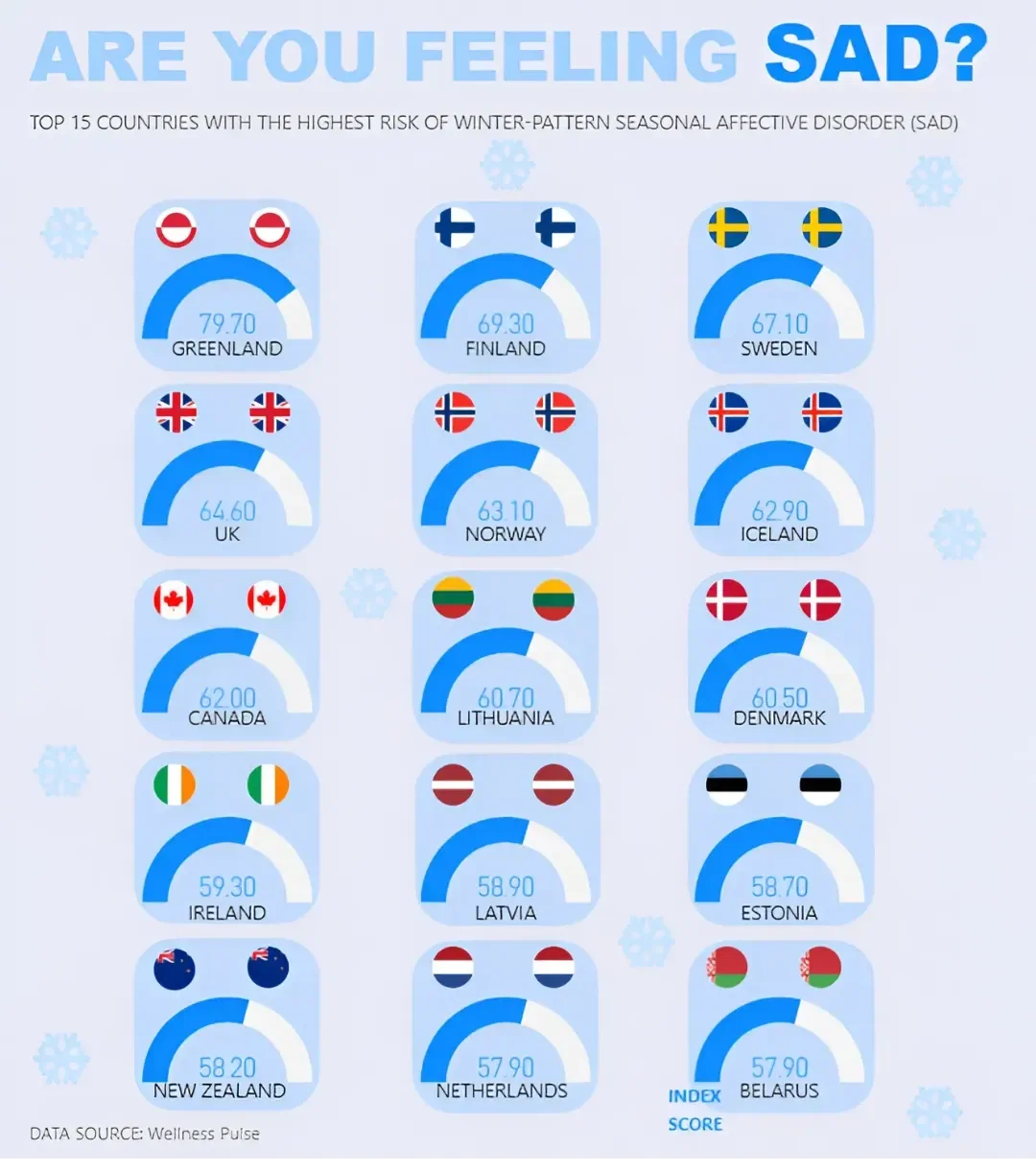
Risk of SAD by country, taken from Voronoi.
Since the onset of SAD is related to lack of sunlight, it is no surprise that people in Nordic countries are most at risk for developing this condition. According to this image, SAD is seen the highest in Greenland, Finland, and Sweden. For instance, Oslo can get as little as 6-7 hours of daylight in the winter months, compared to the 9-10 hours in New York City, or 8-9 hours in Paris (WorldData.Info, n.d.).
Symptoms of Seasonal Affective Disorder
Symptoms of SAD are often diagnostically similar to depression.
These symptoms include:
- A persistent feeling of sadness, anxiety, or emptiness that lasts most of the day, nearly every day, for at least two weeks
- A sense of hopelessness or negative outlook on the future
- Irritability, frustration, or restlessness that’s difficult to control
- Strong feelings of guilt, worthlessness, or helplessness
- Losing interest or enjoyment in hobbies, socializing, or activities once found pleasurable
- Low energy, ongoing fatigue, or a sense of being physically slowed down
- Trouble focusing, remembering details, or making decisions
- Noticeable changes in sleep patterns, appetite, or unexpected weight gain or loss
- Unexplained physical discomforts such as aches, headaches, cramps, or digestive issues that don’t improve with treatment
- Recurring thoughts of death, suicidal ideation, or attempts at self-harm
*Symptoms taken from (National Institute of Health, 2023)
Causes of Seasonal Affective Disorder
Why Do People Get SAD?
While causes of SAD are generally unclear, there are many theories as to its causes. Some theories include:
- Decreased Serotonin Levels - Luminosity levels have been seen to regulate serotonin production, with levels decreasing in fall and winter months with reduced sunlight, and increasing during summer months (Lambert et al., 2002). A reduction of serotonin levels can then lead to depressive symptoms (Moncrieff et al., 2022).
- Disruption of Circadian Rhythm - One hypothesis surrounding the effect of a circadian rhythm on SAD is called the photoperiod hypothesis. This hypothesis suggests that shorter daylight hours in winter extend melatonin secretion, which may trigger depression in susceptible individuals (Lewy et al., 2009). The second hypothesis, the phase-shift hypothesis, argues that a mismatch between circadian rhythms and sleep patterns can contribute to SAD symptoms (Kripke et al., 2015).
- Reduced Retinal Sensitivity - The retinal subsensitivity hypothesis suggests that a reduced retinal response to lower light levels in winter disrupts circadian regulation and may play a role in the development of SAD (Rohan et al., 2022). This is due to our retinal cells from vision being directly connected to mood-regulating parts of the brain (Bedrosian & Nelson, 2017).
Current Treatments for SAD
Managing SAD often requires a multifaceted approach. Some common treatments recommended by providers include:
Bright Light Therapy for SAD
By far, the most common and robustly researched treatment for SAD is Bright Light Therapy. In this intervention, individuals will sit in front of a light therapy lamp typically for around 30 mins, while bright light is emitted from the lamp (Terman & Terman, 2005). While white light is commonly used for this treatment, there is some evidence to suggest the use of near infrared light may be equally as effective (Meesters et al., 1999), especially when it comes to its impact on sleep.
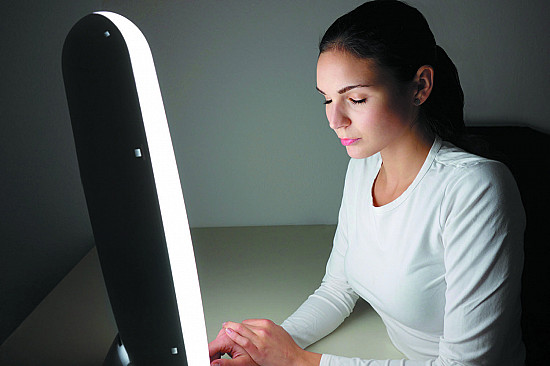
Light therapy for SAD, taken from Thinkstock
Medication for SAD
With serotonin deficiencies being implicated in this condition, providers will often prescribe selective serotonin reuptake inhibitors (SSRIs) either as a standalone intervention, or paired with light therapy (Munir, Gunturu & Abbas, 2024).
Vitamin D
Since SAD affects people during winter months where bodily production of vitamin D is low, some providers will recommend supplementing with vitamin D (Praschak-Rieder & Willeit, 2003).
Cognitive Behavioral Therapy
Another common treatment for SAD is cognitive behavioral therapy (CBT). Here, individuals are taught to modify maladapative thought patterns and behaviors that may contribute to depression (Munir, Gunturu & Abbas, 2024). In fact, there is a specific form of CBT adapted to SAD called “CBT-SAD” that addresses negative thoughts linked to seasonal changes and applies behavioral activation strategies (Meyerhoff, Young & Rohan, 2019).
Exercise
Physical exercise, often in the form of aerobic exercise, is often recommended as a treatment for depressive disorders (Drew, Hanson & Huo, 2021). One study by Pinchasov et al., (2000) found that people with seasonal depression responded equally well to exercise as to light therapy.
Hope and Outlook for People with SAD
Seasonal affective disorder represents a recurrent depressive condition with multifactorial etiologies involving circadian dysregulation, neurotransmitter alterations, and retinal sensitivity. Luckily, there are various treatment options providers will often recommend. Current evidence supports a multimodal approach to management, with light therapy remaining the most extensively validated intervention, complemented by pharmacological treatments, vitamin D supplementation, and cognitive behavioral therapy. Continued investigation into the neurobiological mechanisms underlying SAD will be critical for refining treatment strategies and improving outcomes for affected individuals.
References:
American Psychiatric Association. (2024, March). Seasonal Affective Disorder (SAD). Psychiatry.org. https://www.psychiatry.org/patients-families/seasonal-affective-disorder
Drew, E. M., Hanson, B. L., & Huo, K. (2021). Seasonal affective disorder and engagement in physical activities among adults in Alaska. International Journal of Circumpolar Health, 80(1), 1906058. https://doi.org/10.1080/22423982.2021.1906058
Lambert, G. W., Reid, C., Kaye, D. M., Jennings, G. L., & Esler, M. D. (2002). Effect of sunlight and season on serotonin turnover in the brain. Lancet, 360(9348), 1840-1842. https://doi.org/10.1016/S0140-6736(02)11737-5
Lewy, A. J., Emens, J. S., Songer, J. B., Sims, N., Laurie, A. L., Fiala, S. C., & Buti, A. (2009). Winter depression: Integrating mood, circadian rhythms, and phototherapy. Sleep Medicine Clinics, 4(2), 285-299. https://doi.org/10.1016/j.jsmc.2009.02.003
Kripke, D. F., Elliott, J. A., Welsh, D. K., & Youngstedt, S. D. (2015). Photoperiodic and circadian bifurcation theories of depression and mania. F1000Research, 4, Article 107. https://doi.org/10.12688/f1000research.6444.1
Meesters, Y., Beersma, D. G., Bouhuys, A. L., & van den Hoofdakker, R. H. (1999). Prophylactic treatment of seasonal affective disorder (SAD) by using light visors: bright white or infrared light? Biological Psychiatry, 46(2), 239-246. https://doi.org/10.1016/S0006-3223(98)00252-2
Meyerhoff, J., Young, M. A., & Rohan, K. J. (2018). Patterns of depressive symptom remission during the treatment of seasonal affective disorder with cognitive-behavioral therapy or light therapy. Depression and Anxiety, 35(5), 457–467. https://doi.org/10.1002/da.22739
Moncrieff, J., Cooper, R. E., Stockmann, T., Amendola, S., Hengartner, M. P., & Horowitz, M. A. (2022). The serotonin theory of depression: A systematic umbrella review of the evidence. Molecular Psychiatry, 28(7), 3243-3256. https://doi.org/10.1038/s41380-022-01661-0
Munir, S., Gunturu, S., & Abbas, M. (2024, April 20). Seasonal Affective Disorder. In StatPearls. StatPearls Publishing. https://www.ncbi.nlm.nih.gov/books/NBK568745/
National Institute of Mental Health. (2023). Seasonal Affective Disorder. U.S. Department of Health and Human Services. https://www.nimh.nih.gov/health/publications/seasonal-affective-disorder
Roecklein, K. A., DelBello, M. P., Valatura, C., Cormier, R., Wong, K., Gillin, J. C., & Postolache, T. T. (2017). A pilot study of near-infrared light therapy for seasonal affective disorder: Acute changes in late afternoon serum aggrecan and chondroitin sulfate. Journal of Psychiatric Research, 93, 133-141. https://doi.org/10.1016/j.jpsychires.2017.07.006
Rohan, K. J., Franzen, P. L., Roecklein, K. A., Siegle, G. J., Kolko, D. J., Postolache, T. T., & Vacek, P. M. (2022). Elucidating treatment targets and mediators within a confirmatory efficacy trial: Study protocol for a randomized controlled trial of cognitive-behavioral therapy vs. light therapy for winter depression. Trials, 23(1), Article 383. https://doi.org/10.1186/s13063-022-06330-9
Terman, M., & Terman, J. S. (2005). Light therapy for seasonal and nonseasonal depression: Efficacy, protocol, safety, and side effects.CNS Spectrums, 10(8), 647–663. https://doi.org/10.1017/S1092852900019611
Voronoi App. (n.d.). The top countries with the highest risk of winter SAD are from Europe. Retrieved [Month Day, Year], from https://www.voronoiapp.com/other/The-top-countries-with-the-highest-risk-of-winter-SAD-are-from-Europe-4292
WorldData. (n.d.). Norway: Sunset times. Retrieved [October 1, 2025], from https://www.worlddata.info/europe/norway/sunset.php