Winter Blues: Understanding & Overcoming Seasonal Affective Disorder
![[object Object]](https://cdn.sanity.io/images/h29o7kl4/staging/ff53226fede55001781c911b5171e43dd7477ade-795x795.webp?w=795&q=80&auto=format&fit=max)

Winter Blues: Understanding & Overcoming Seasonal Affective Disorder
As the seasons shift, many of us notice subtle changes.. shorter days, an urge to stay indoors and a dip in energy.
For some, these shifts bring more than a change in mood, they can trigger Seasonal Affective Disorder (SAD).
In this issue, we’ll explore: • How to recognize the signs of depression & SAD • The science behind why they happen • Proven strategies to lift your mood & restore energy
Clinical depression can arise any time of year, often from a complex interplay of biological, psychological and social factors.
On the other hand, SAD is a subtype of depression that recurs in a seasonal pattern when daylight decreases. It’s more than just feeling winter blues, it’s a biological response to a lack of sunlight [1].
The U.S. National Institute of Mental Health describes SAD as a clinically recognized “seasonal depression” tied to reduced daylight hours [2].
Recognizing the symptoms
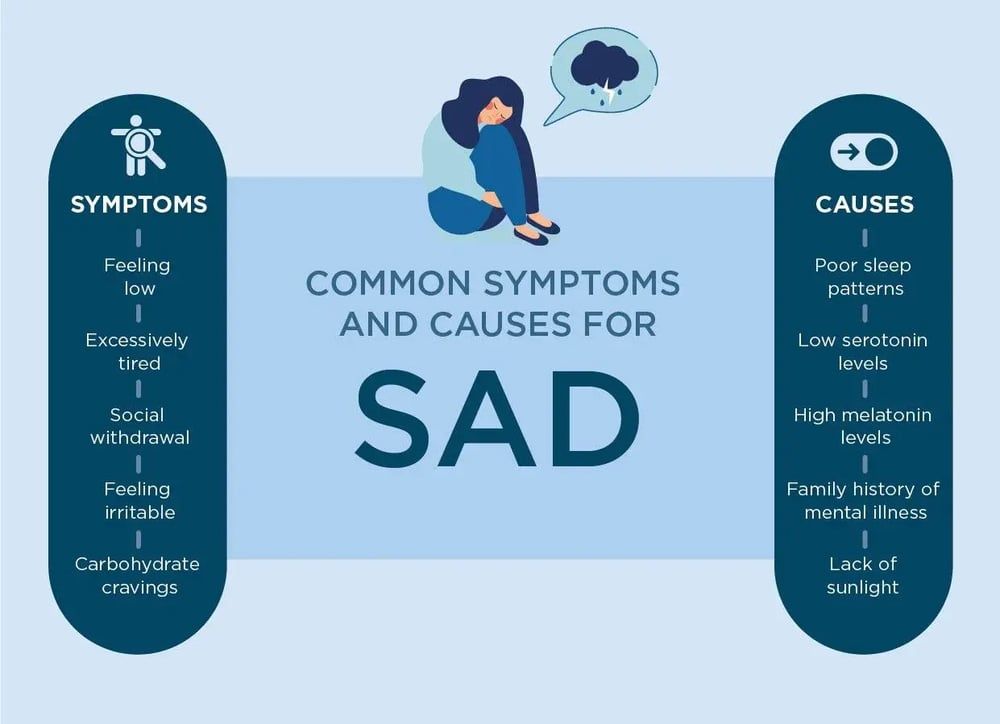
- Persistent sadness, emptiness or anxiety
- Hopelessness or negative outlook
- Irritability & restlessness
- Loss of interest or pleasure in activities
- Low energy & fatigue
- Difficulty concentrating or making decisions
- Oversleeping
- Increased appetite
- Aches, headaches & digestive issues
Because these symptoms overlap with non-seasonal depression, the pattern of timing is key to distinguishing SAD.
Who’s affected?
SAD tends to begin in young adulthood and approximately 5% of people in the U.S. experience SAD at some point each year. That’s roughly 17 million individuals. Geographic risk is higher in latitudes with longer, darker winters and the typical duration of symptoms is 4 to 5 months per year during the darker periods [3]. In a population study from Sweden (Chotai et al), women had about 1.5 times the prevalence of SAD compared with men. This is attributed to women experiencing cyclical changes in hormones such as estrogen and progesterone which modulate neurotransmitters like serotonin and melatonin, both of which are implicated in SAD.
Why SAD happens
Most people don't realize that hormones like leptin, cortisol and melatonin shift seasonally. Hormones are controlled by light so the right or wrong light at the right or wrong time can lead to biological confusion and depressive symptoms. It’s likely that multiple mechanisms combine to increase vulnerability to SAD but the main causes are attributed to:
- Serotonin dysregulation: Less sunlight reduces serotonin turnover, contributing to depressive symptoms [4][5].
- Circadian rhythm disruption: Shorter daylight periods can shift melatonin cycles, leading to a mismatch between internal body clocks and daily life [6][7].
- Retinal sensitivity: Reduced light may diminish input from retinal cells that help regulate mood and circadian rhythms [8].
Evidence-Based Treatments
Because SAD is complex, most effective care uses a multimodal approach. Here are key interventions:
Bright Light Therapy (BLT)
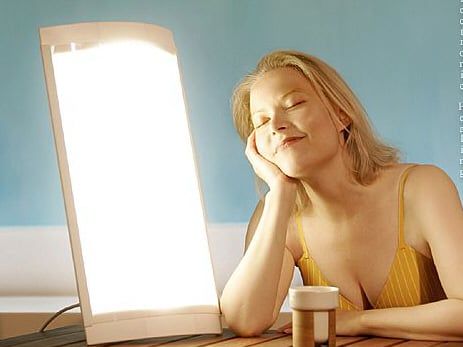
BLT is the most robustly studied treatment for SAD,
In practice, this involves spending about 30 minutes each morning near a light box emitting 10,000 lux - a measure of brightness. For context, a sunny day outdoors can reach around 100,000 lux, while typical office lighting is under 500 lux. Lux is crucial for mental health because it directly influences the body’s circadian rhythms, hormone production and neurotransmitter balance [9][10]. Variations of BLT devices include broad-spectrum bright white light and near-infrared light [11][12].
Vitamin D
Sunlight exposure decreases in winter reducing the amount of ultraviolet B which is necessary for vitamin D synthesis. Vitamin D affects neurotransmitter synthesis and mental health, thus supplementation is sometimes recommended as an adjunct [13].
Exercise & Physical Activity
Regular aerobic exercise is well supported in depressive disorders, and may help in SAD too. One study found that in people with seasonal depression, exercise responses were comparable to light therapy. [14]
PBM & SAD
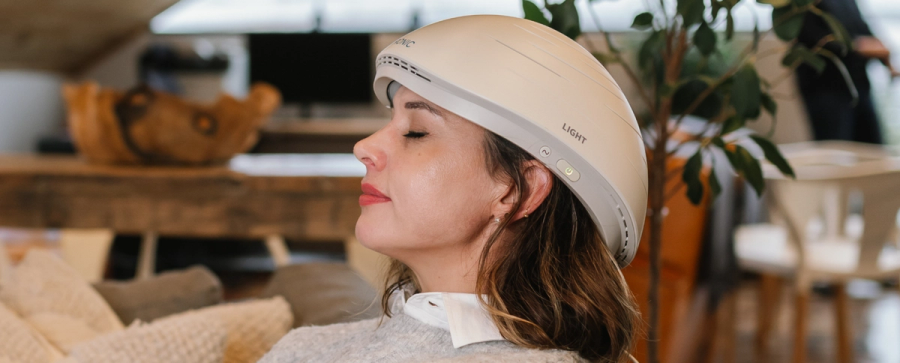
As the darker months set in, our brains and bodies feel the impact of reduced natural light. Near-infrared (NIR) light offers a fascinating way to counteract this seasonal dip from the inside out. By penetrating deep into brain tissue, NIR light energises the mitochondria, the tiny batteries within our cells, helping them produce more ATP, the energy currency that keeps our neurons firing and our minds sharp and clear.
This light also boosts blood flow and oxygen delivery to key brain regions linked to emotional balance and focus, while easing oxidative stress and inflammation that can dampen mood.
While research in this area is still evolving, the results are promising: NIR light therapy may help lift the winter fog and restore that sense of mental brightness we often lose with shorter days when the sun is scarce and we can't spend as much time outdoors.
More Helpful Tips
Even outside of formal treatment, these practices can help support mental wellness through the darker months:
- Spend time outdoors during daylight, especially around midday • Use full-spectrum indoor lighting and minimize artificial light after dark • Keep a consistent sleep schedule to anchor your circadian rhythm • Stay socially connected, even when you feel like withdrawing • Engage in enjoyable, active pursuits such as hobbies and exercise • Reach out for support early when symptoms begin rather than waiting for them to intensify
References
- National Institute of Mental Health. (2023). Seasonal Affective Disorder. U.S. Department of Health and Human Services.
- Ibid.
- “Seasonal Affective Disorder: Symptoms, Statistics and Treatments,” Neuronic blog (Nicole Greig, October 2, 2025)
- Lambert, G. W., Reid, C., Kaye, D. M., Jennings, G. L., & Esler, M. D. (2002). Effect of sunlight and season on serotonin turnover in the brain. Lancet, 360(9348), 1840-1842.
- Moncrieff, J., Cooper, R. E., Stockmann, T., Amendola, S., Hengartner, M. P., & Horowitz, M. A. (2022). The serotonin theory of depression: A systematic umbrella review of the evidence. Molecular Psychiatry, 28(7), 3243-3256.
- Lewy, A. J., Emens, J. S., Songer, J. B., Sims, N., Laurie, A. L., Fiala, S. C., & Buti, A. (2009). Winter depression: Integrating mood, circadian rhythms, and phototherapy. Sleep Medicine Clinics, 4(2), 285-299.
- Kripke, D. F., Elliott, J. A., Welsh, D. K., & Youngstedt, S. D. (2015). Photoperiodic and circadian bifurcation theories of depression and mania. F1000Research, 4, Article 107.
- Rohan, K. J., Franzen, P. L., Roecklein, K. A., Siegle, G. J., Kolko, D. J., Postolache, T. T., & Vacek, P. M. (2022). Elucidating treatment targets and mediators within a confirmatory efficacy trial: Study protocol for a randomized controlled trial of cognitive-behavioral therapy vs. light therapy for winter depression. Trials, 23(1), Article 383.
- Terman, M., & Terman, J. S. (2005). Light therapy for seasonal affective disorder: A review of efficacy. Neuropsychopharmacology, 30(2), 84-97.
- Terman, M., Terman, J. S., & Ross, D. C. (1998). A controlled trial of timed bright light and negative air ionization for treatment of winter depression. Archives of General Psychiatry, 55(10), 875-882.
- Meesters, Y., Beersma, D. G., Bouhuys, A. L., & van den Hoofdakker, R. H. (1999). Prophylactic treatment of seasonal affective disorder (SAD) by using light visors: bright white or infrared light? Biological Psychiatry, 46(2), 239-246.
- Roecklein, K. A., DelBello, M. P., Valatura, C., Cormier, R., Wong, K., Gillin, J. C., & Postolache, T. T. (2017). A pilot study of near-infrared light therapy for seasonal affective disorder: Acute changes in late afternoon serum aggrecan and chondroitin sulfate. Journal of Psychiatric Research, 93, 133-141.
- Praschak-Rieder, N., & Willeit, M. (2003). [Vitamin D and seasonal affective disorder]. Biological Psychiatry (as cited in the Neuronic article).
- Drew, E. M., Hanson, B. L., & Huo, K. (2021). Seasonal affective disorder and engagement in physical activities among adults in Alaska. International Journal of Circumpolar Health, 80(1), 1906058.

Subscribe for insights, tips, offers & more.
By signing up, you accept our privacy policy. Your personal data will be processed so that we can contact you about our products. Read our Privacy Policy for more information.