Autism Spectrum Disorder (ASD): Symptoms, Causes and the Potential of Photobiomodulation
![[object Object]](https://cdn.sanity.io/images/h29o7kl4/staging/0d3cee8b2dae17d59cfa567479c79a430b33b797-500x500.png?w=500&q=80&auto=format&fit=max)
What is Autism Spectrum Disorder (ASD)?
Autism Spectrum Disorder (ASD) is a neurodevelopmental disorder that involves challenges with social skills, repetitive behaviors, speech and nonverbal communication. It affects the structure and function of the brain, leading to imbalances in how different regions communicate, and how neurons fire (Smith et al., 2018).
According to the Center for Disease Control, 3.2% of children aged 8 years old have been identified with ASD (Shaw et. al, 2025). Although ASD can be diagnosed at any stage of life, the majority of diagnoses occur in childhood.
We know that most children with ASD also present severe behavioral difficulties, including aggression, self-injurious behavior, tantrums, irritability, and sleep problems, which usually interfere with their education and development as well as the well-being of caregivers (Hamilton et al., 2022).
Currently, there are limited treatment options for autism, mainly focused on managing symptoms through early intervention strategies, behavioral therapies, and medications for co-existing conditions.
Common Symptoms of Autism
Symptoms of ASD vary, but some common characteristics include:
- Avoiding eye contact
- Does not notice when others are hurt or upset by 2 years of age
- Does not engage in pretend play by 2 years of age
- Has obsessive interests
- Repeats words or phrases over and over (called echolalia)
- Flaps hands, rocks body, or spins self in circles
*Find a full list of symptoms and diagnostic criteria on the CDC website.
What causes Autism (ASD)?
Although autism can present in a wide variety of ways and is linked to multiple possible causes, researchers have identified certain recurring biological patterns. Pinpointing reliable biomarkers for the condition has proven difficult, largely because of limited sample sizes and a lack of consistently replicated results in human studies. Still, several notable findings have emerged in the literature.
- Mitochondrial dysfunction - Rossignol and Frye (2012) reported that mitochondrial dysfunction occurs in about 5.0% of individuals with ASD - dramatically higher than the ~0.01% rate observed in the general population. They also noted associations between these mitochondrial biomarkers and ASD symptom severity, suggesting that mitochondrial dysfunction may contribute to the condition’s clinical features.
- Early brain overgrowth - Neuroimaging studies have most consistently revealed early brain overgrowth as a hallmark characteristic of ASD. This excessive growth can disrupt normal neural development and is often tied to greater symptom severity (Anagnostou & Taylor, 2011). Postmortem analyses further support these findings, showing increased neuronal growth in the prefrontal cortex of individuals with ASD, a pattern also observed in other neurodevelopmental disorders such as ADHD (Courchesne et al., 2011).
- Neurotransmitter imbalances - Abnormalities in neurotransmitter systems - particularly those involving serotonin, dopamine, and glutamate - have been implicated in ASD symptomatology (Marotta et al., 2020).
- Genes and Environment - Similar to other conditions, autism arises from a complex interplay of genetics and environment. While genes play a strong role, there's no single "autism gene." The environment, including maternal health during pregnancy and exposure to certain factors, may interact with these genetic predispositions. Despite that, studies suggest that maternal nutrition, autoimmune disease and inflammation, and/or exposure to air pollutants (e.g., heavy metals) or various drugs (e.g., thalidomide or valproic acid) during preconception and pregnancy can aggravate a genetic problem or damage the brain, increasing the risk of autism (Santos et al., 2022).
Light Therapy and Autism
Light therapy, also known as photobiomodulation (PBM), offers hope for individuals with autism. This intervention involves applying red and near-infrared light to the body. While it sounds simple, the potential benefits for autism are quite significant.
Here's how photobiomodulation works, according to research:
- Increasing Cellular Energy: The light may stimulate the production of ATP, a molecule essential for energy production within neurons, promoting their health and survival (Waisberg et al., 2024).
- Calming Inflammation: PBM has the potential to influence the activation of glial cells, which are involved in the brain's inflammatory response, leading to a calmer brain environment (Saieva & Taglialatela, 2022)
- Supporting Neuroplasticity: Research shows PBM is able to enhance neuroplasticity through increasing neurogenesis and synaptogenesis (Chaieb et al., 2015).
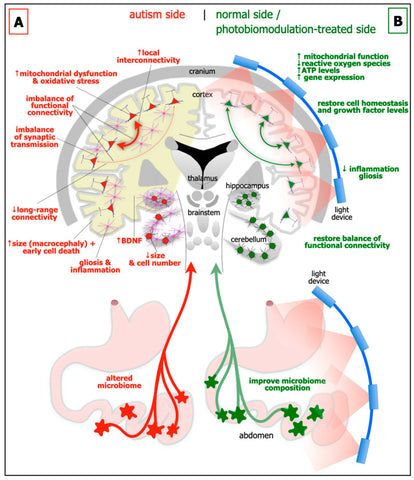
Credits: Hamilton, C. et al. (2022) [3]
The diagram illustrates potential brain and gut abnormalities in autism (smaller cerebellum, altered gut bacteria, poor brain connectivity, cellular imbalance, inflammation, and others) and how photobiomodulation might improve communication, cell function, and overall brain health.
Various studies show improvements in individuals with autism after using light therapy:
- Pallanti et al. (2022) reported that PBM sessions led to improvements in ASD symptoms, as shown by reduced scores on the Childhood Autism Rating Scale (CARS). The study also noted a decline in parental stress, which can enhance caregivers’ quality of life and create a more supportive environment for the development of children with ASD.
- A recent 2025 study investigated the effects of near-infrared light pulsed at 40 Hz in children with ASD (Fradkin et al., 2025). The intervention produced a significant 7-point reduction in average CARS-2 scores, along with EEG changes characterized by decreased delta power and increased gamma and beta activity.
- In another trial, Ceranoglu et al. (2022) evaluated high-functioning ASD participants aged 18–59 years who underwent tPBM twice weekly for eight weeks. Results indicated improvements on the Social Responsiveness Scale-2, including gains in social awareness, communication, motivation, and reductions in restricted/repetitive behaviors from baseline to study endpoint.
Photobiomodulation Safety
The safety profile of photobiomodulation is another reason for optimism (Fradkin et al., 2024). It has a well-established safety record with minimal side effects :
- Non-invasive and painless
- Minimal side effects
- Suitable for both children and adults
- Easy to use with home-based PBM devices
These advantages make PBM an attractive option for long-term autism care.
Case Study: Potential Benefits of Photobiomodulation and Neurofeedback for Autism Spectrum Disorder (ASD)
This case study, conducted by Roger Lee, FSERA®, MSc, founder of Brain Infinity Neurofeedback, explored the potential benefits of a combined approach for ASD. Lee's organization focuses on utilizing scientific methodologies to alleviate symptoms of various mental health conditions, including ADHD, ASD, and mood disorders.
The case study involved a child with ASD, identified as C.C.K., who underwent a photobiomodulation protocol using the Neuradiant 1070 device by Neuronic. These sessions were complemented by swLORETA, an advanced form of neurofeedback (NF). swLORETA provides auditory or visual feedback based on real-time analysis of brain network activity across the cortex, cerebellum, and specific subcortical structures.
Pre-Treatment Challenges
- Limited verbal ability and comprehension
- Difficulty identifying teachers
- Frequent speech disfluency
- Low cognitive and social performance
Pre and Post-Intervention EEG Analysis
An analysis of C.C.K.'s pre-PBM EEG, shown below, revealed several abnormalities. These included reduced power in lower frequency bands, excessive power in the beta and high-beta frequencies, and overall diminished coherence across various frequency bands. Notably, a follow-up EEG conducted three months later (post-PBM) demonstrated significant improvements in all these parameters.
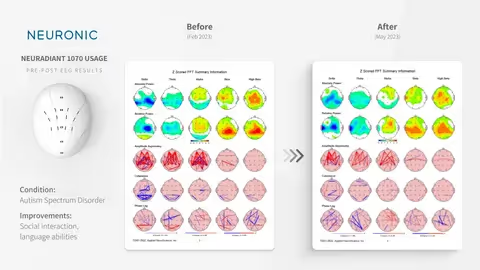
C.C.K. pre and post-EEG
Neurofeedback on its own led to moderate symptom improvement in C.C.K.; however, when paired with PBM, the gains were substantially greater. C.C.K’s improvements include:
- Improved ability to identify his teachers by name, albeit with a slight delay of two to three seconds.
- Ability to confidently greet and farewell his teachers verbally without hesitation.
- Developed the ability to express his emotions verbally and communicate his desires.
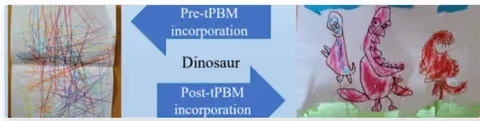
- Completed a drawing of a dinosaur for the first time after verbal instructions from his teacher, which noted improved receptive language skills.
Credits: Roger Lee
Conclusion
Currently available options for autism often focus on managing symptoms rather than addressing the underlying neurological abnormalities that contribute to the condition. The sheer complexity and variation in how ASD manifests further complicates the development of effective, broad-spectrum treatments.
Photobiomodulation has shown promise in improving some of the key brain function and microbiome changes observed in ASD. This is particularly exciting as photobiomodulation boasts several advantages: it has a very safe profile with minimal to no side effects, it's non-invasive, and the devices used are user-friendly, leading to high patient compliance.
This blog was last updated on October 6th, 2025
References
Anagnostou, E., & Taylor, M. J. (2011). Review of neuroimaging in autism spectrum disorders: What have we learned and where do we go from here. Molecular Autism, 2(1), 4. https://doi.org/10.1186/2040-2392-2-4
Chaieb, L., Antal, A., Masurat, F., & Paulus, W. (2015). Neuroplastic effects of transcranial near-infrared stimulation (tNIRS) on the motor cortex. Frontiers in Behavioral Neuroscience, 9. https://doi.org/10.3389/fnbeh.2015.00147
Courchesne, E., Mouton, P. R., Calhoun, M. E., Semendeferi, K., Ahrens‑Barbeau, C., Hallet, M. J., Barnes, C. C., & Pierce, K. (2011). Neuron number and size in prefrontal cortex of children with autism. JAMA, 306(18), 2001–2010. https://doi.org/10.1001/jama.2011.1638
Fradkin, Y., De Taboada, L., Naeser, M., Saltmarche, A., Snyder, W., & Steingold, E. (2024). Transcranial photobiomodulation in children aged 2–6 years: A randomized sham-controlled clinical trial assessing safety, efficacy, and impact on autism spectrum disorder symptoms and brain electrophysiology. Frontiers in Neurology, 15, Article 1221193. https://doi.org/10.3389/fneur.2024.1221193
Hamilton, C., Liebert, A., Pang, V., Magistretti, P., & Mitrofanis, J. (2022). Lights on for Autism: Exploring Photobiomodulation as an Effective Therapeutic Option. Neurology International, 14(4), 884–893. https://doi.org/10.3390/neurolint14040071
Maenner MJ, Warren Z, Williams AR, et al. Prevalence and Characteristics of Autism Spectrum Disorder Among Children Aged 8 Years — Autism and Developmental Disabilities Monitoring Network, 11 Sites, United States, 2020. MMWR Surveill Summ 2023;72(No. SS-2):1–14. DOI: http://dx.doi.org/10.15585/mmwr.ss7202a1.
Marotta, R., Risoleo, M. C., Messina, G., Parisi, L., Carotenuto, M., Vetri, L., & Roccella, M. (2020). The neurochemistry of autism. Brain Sciences, 10(3), 163. https://doi.org/10.3390/brainsci10030163
Pallanti, S., Di Ponzio, M., Grassi, E., Vannini, G., & Cauli, G. (2022). Transcranial Photobiomodulation for the Treatment of Children with Autism Spectrum Disorder (ASD): A Retrospective Study. Children (Basel, Switzerland), 9(5), 755. https://doi.org/10.3390/children9050755
Rossignol, D. A., & Frye, R. E. (2012). Mitochondrial dysfunction in autism spectrum disorders: A systematic review and meta-analysis. Molecular Psychiatry, 17(3), 290–314. https://doi.org/10.1038/mp.2010.136
Saieva, S., & Taglialatela, G. (2022). Near-infrared light reduces glia activation and modulates neuroinflammation in the brains of diet-induced obese mice. Scientific Reports, 12, Article 10848. https://doi.org/10.1038/s41598-022-14812-8
Santos, J. X., Rasga, C., Marques, A. R., Martiniano, H., Asif, M., Vilela, J., Oliveira, G., Sousa, L., Nunes, A., Vicente, A. M. (2022). A role for gene-environment interactions in autism spectrum disorder is supported by variants in genes regulating the effects of exposure to xenobiotics. Frontiers in Neuroscience, 16. https://doi.org/10.3389/fnins.2022.862315
Santarone, M. E., Zambrano, S., Zanotta, N., Mani, E., Minghetti, S., Pozzi, M., Villa, L., Molteni, M., & Zucca, C. (2023). EEG Features in Autism Spectrum Disorder: A Retrospective Analysis in a Cohort of Preschool Children. Brain sciences, 13(2), 345. https://doi.org/10.3390/brainsci13020345
Shaw, K. A., Williams, S., Patrick, M. E., Valencia-Prado, M., Durkin, M. S., Howerton, E. M., … Zahorodny, W. (2025). Prevalence and early identification of autism spectrum disorder among children aged 4 and 8 years — Autism and Developmental Disabilities Monitoring Network, 16 sites, United States, 2022. Morbidity and Mortality Weekly Report. Surveillance Summaries, 74(2), 1–22. https://www.cdc.gov/mmwr/volumes/74/ss/ss7402a1.htm
Smith, R. X., Jann, K., Dapretto, M., & Wang, D. J. J. (2018). Imbalance of functional connectivity and temporal entropy in resting-state networks in autism spectrum disorder: A machine learning approach. Frontiers in Neuroscience, 12. https://doi.org/10.3389/fnins.2018.00869
Waisberg, E., Ong, J., Masalkhi, M., & Lee, A. G. (2024). Near infrared/red light therapy: A potential countermeasure for mitochondrial dysfunction in spaceflight-associated neuro-ocular syndrome (SANS). Eye, 38(9), 2499–2501. https://doi.org/10.1038/s41433-024-03091-4
![[object Object]](https://cdn.sanity.io/images/h29o7kl4/staging/0c0476690b5e49f9a375deb663c4d52aa39fa8e2-352x351.heif?w=352&q=80&auto=format&fit=max)