Mitochondrial Dysfunction: Causes, Symptoms, and How Light Can Help Restore Energy
![[object Object]](https://cdn.sanity.io/images/h29o7kl4/staging/ff53226fede55001781c911b5171e43dd7477ade-795x795.webp?w=795&q=80&auto=format&fit=max)
Mitochondrial Dysfunction
Mitochondria are often called the “powerhouses of the cell,” but when they stop working properly, the consequences can ripple across your entire body. From fatigue and brain fog to neurodegenerative disease, mitochondrial dysfunction is now recognized as a core driver of many chronic conditions. Fortunately, emerging science points to targeted interventions like photobiomodulation (PBM) that may help restore healthy energy production.
What Is Mitochondrial Dysfunction?
While only 1% of diseases are officially classified as primary mitochondrial disorders, mitochondrial dysfunction is a ubiquitous and central feature in a wide range of chronic diseases, such as neurodegenerative, metabolic, cardiovascular and autoimmune conditions (Diaz-Vegas et al., 2020). Mitochondrial dysfunction can manifest as:
- fatigue
- brain fog
- memory problems
- muscle weakness
- poor metabolic health
- insulin resistance
- inflammation
- & more
Mitochondrial dysfunction occurs when the mitochondria, the cellular batteries in every cell except red blood cells, can’t produce energy efficiently. Mitochondria are responsible for producing energy, by running nutrients and oxygen through biochemical pathways they create adenosine triphosphate (ATP), one of the primary energy molecules required for all cellular processes.
Mitochondrial dysfunction results from an inefficiency in the electron transport chain, the site of ATP synthesis (Zong et al., 2024). This leads to excess reactive oxygen species and less ATP production. Even a subtle inefficiency in ATP synthesis can have wide-reaching effects, dysfunction can show up in almost any organ system, especially those with high energy demands like the brain, heart, liver, muscles and endocrine glands (Song et al., 2024) (Zhang et al., 2025).
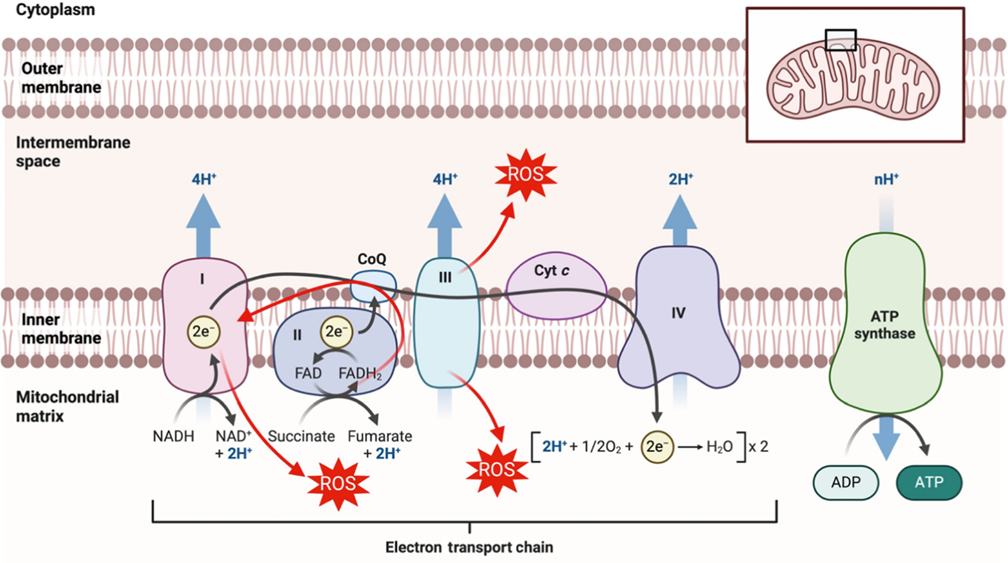
(Zotta et al., 2024)
Why Mitochondria Matter for Brain Health
The brain comprises approximately 2% of body weight, yet it consumes around 20% of the body's energy, making it particularly sensitive to reductions in mitochondrial function. Neurons do not regenerate readily, and if mitochondrial failure occurs, these cells are not easily replaced, which helps explain why mitochondrial dysfunction is central in neurodegenerative disorders. In the United States, the prevalence of mitochondrial disease is estimated at approximately 1 in 4,000 individuals, with a similar global estimate of about 1 in 5,000 (Buajitti et al., 2022).
Mitochondrial dysfunction is implicated in conditions such as:
- Alzheimer’s and Parkinson’s disease
- Autism spectrum disorder
- ADHD
- Cardiovascular disease
- Autoimmune disorders
How Photobiomodulation (PBM) Supports Mitochondria
Photobiomodulation (PBM) uses red and near-infrared (NIR) light to target mitochondrial function. The underlying mechanism involves cytochrome c oxidase (CCO), a mitochondrial enzyme that absorbs light, triggering several downstream effects. PBM improves MD by increasing ATP production, inducing acute ROS in a regulated manner, modulates nitric oxide pathways and can activate transcriptional responses that enhance cell survival and function (Hamblin, 2017).
Mitochondrial Dysfunction and Common Conditions
Mitochondrial dysfunction is also implicated in autism spectrum disorder symptoms, PBM can be a great option to support optimal mitochondrial functioning via increased ATP generation (Rossignol & Frye, 2012; Hamblin, 2019).
Individuals with ADHD show decreased mitochondrial respiration, and reduced mitochondrial complex V activity. With PBM acting on CCO in the electron transport chain, it improves downstream activity through increasing ATP production (Verma et al., 2016).
Additionally, studies in cultured neurons show that NIR light restores CCO activity, increases ATP and decreases cell death caused by mitochondrial toxins (Wong-Riley et al., 2005). Organ-level effects are seen in animal models where PBM reverses age-related decline in CCO activity and improves mitochondrial function across multiple brain regions (Cardoso et al., 2022).
Mitochondrial Dysfunction: Key Drivers and Targeted Interventions
Mitochondrial dysfunction can arise from genetic, environmental and lifestyle factors, such influences include toxin exposure, infections, inadequate nutrition, physical inactivity, chronic inflammation and medications. Additionally, mitochondria are particularly sensitive to disruptions in light exposure such as circadian misalignment.
- Morning sunlight exposure: Aligns circadian rhythms and supports mitochondrial enzyme activation.
- Physical activity: Aerobic exercise, high-intensity interval training and strength training increase mitochondrial number and efficiency.
- Nutrition: Adequate protein, healthy fats and micronutrients such as CoQ10, magnesium and B vitamins.
- Temperature stress: Cold exposure and sauna use promote mitochondrial resilience.
- Sleep quality: Deep, consistent sleep supports repair and regeneration.
- Reduce exposure to toxins: Limit alcohol, smoking, pollutants and pesticides.
Bottom Line
Mitochondrial dysfunction hampers cellular energy production across multiple organ systems and carries significant implications for disease risk. Photobiomodulation offers a scientifically supported method to enhance mitochondrial function and overall health by enhancing mitochondrial function. Supporting mitochondrial health through infrared light exposure, exercise, nutrition, sleep, and reduced toxin exposure is essential for maintaining cellular and systemic health.
References
Buajitti, E., Rosella, L. C., Zabzuni, E., Trevor Young, L., & Andreazza, A. C. (2022). Prevalence and health care costs of mitochondrial disease in Ontario, Canada: A population-based cohort study. PLoS ONE, 17(4), e0265744. https://doi.org/10.1371/JOURNAL.PONE.0265744
Cardoso, F. dos S., Barrett, D. W., Wade, Z., Gomes da Silva, S., & Gonzalez-Lima, F. (2022). Photobiomodulation of Cytochrome c Oxidase by Chronic Transcranial Laser in Young and Aged Brains. Frontiers in Neuroscience, 16, 818005. https://doi.org/10.3389/FNINS.2022.818005/FULL
Degli Esposti, D., Hamelin, J., Bosselut, N., Saffroy, R., Sebagh, M., Pommier, A., Martel, C., & Lemoine, A. (2012). Mitochondrial roles and cytoprotection in chronic liver injury. Biochemistry Research International. https://doi.org/10.1155/2012/387626
Diaz-Vegas, A., Sanchez-Aguilera, P., Krycer, J. R., Morales, P. E., Monsalves-Alvarez, M., Cifuentes, M., Rothermel, B. A., & Lavandero, S. (2020). Is Mitochondrial Dysfunction a Common Root of Noncommunicable Chronic Diseases? Endocrine Reviews, 41(3), bnaa005. https://doi.org/10.1210/ENDREV/BNAA005
Hamblin, M. R. (2017). Mechanisms and applications of the anti-inflammatory effects of photobiomodulation. AIMS Biophysics, 4(3), 337–361. https://doi.org/10.3934/BIOPHY.2017.3.337,
Song, J., Xiao, L., Zhang, Z., Wang, Y., Kouis, P., Rasmussen, L. J., & Dai, F. (2024). Effects of reactive oxygen species and mitochondrial dysfunction on reproductive aging. Frontiers in Cell and Developmental Biology, 12, 1347286. https://doi.org/10.3389/FCELL.2024.1347286/XML
Verma, P., Singh, A., Nthenge-Ngumbau, D. N., Rajamma, U., Sinha, S., Mukhopadhyay, K., & Mohanakumar, K. P. (2016). Attention deficit-hyperactivity disorder suffers from mitochondrial dysfunction. BBA Clinical, 6, 153–158. https://doi.org/10.1016/J.BBACLI.2016.10.003
Wong-Riley, M. T. T., Liang, H. L., Eells, J. T., Chance, B., Henry, M. M., Buchmann, E., Kane, M., & Whelan, H. T. (2005). Photobiomodulation directly benefits primary neurons functionally inactivated by toxins: Role of cytochrome c oxidase. Journal of Biological Chemistry, 280(6), 4761–4771. https://doi.org/10.1074/JBC.M409650200,
Zhang, X., Gao, Y., zhang, S., Wang, Y., Pei, X., Chen, Y., Zhang, J., Zhang, Y., Du, Y., Hao, S., Wang, Y., & Ni, T. (2025). Mitochondrial dysfunction in the regulation of aging and aging-related diseases. Cell Communication and Signaling 2025 23:1, 23(1), 1–35. https://doi.org/10.1186/S12964-025-02308-7
Zong, Y., Li, H., Liao, P., Chen, L., Pan, Y., Zheng, Y., Zhang, C., Liu, D., Zheng, M., & Gao, J. (2024). Mitochondrial dysfunction: mechanisms and advances in therapy. Signal Transduction and Targeted Therapy 2024 9:1, 9(1), 1–29. https://doi.org/10.1038/s41392-024-01839-8
Zotta, A., O’Neill, L. A. J., & Yin, M. (2024). Unlocking potential: the role of the electron transport chain in immunometabolism. Trends in Immunology, 45(4), 259–273. https://doi.org/10.1016/J.IT.2024.02.002/ASSET/86778184-0E9F-4E9E-8934-B5C966550194/MAIN.ASSETS/GR6.SML