The Future of Alzheimer’s Care? Why Scientists Are Studying NIR Light Therapy
![[object Object]](https://cdn.sanity.io/images/h29o7kl4/staging/ff53226fede55001781c911b5171e43dd7477ade-795x795.webp?w=795&q=80&auto=format&fit=max)

What happens when light meets the Alzheimer's brain?
By Sarah Doheny & The Neuronic Team • August 9 2025
You first notice it at the dinner table.
Your loved one tells the same story three times in a row, each time forgetting they've just said it. Is it just forgetfulness, or could it could be a sign of something bigger?
Memory loss is one of the hallmark symptoms of Alzheimer’s disease, a condition that already affects over 55 million people worldwide and that number is expected to nearly double by 2050 (World Health Organization, 2023).
September is World Alzheimer’s Month, a time to raise awareness and deepen our understanding of this devastating condition. In this newsletter, we’ll break down:
- What Alzheimer’s is and how it impacts the brain
- The science we know so far about its progression
- And the surprising, exciting potential of near-infrared (NIR) light therapy to support brain health
The toll of Alzheimer’s is profound, not just on those diagnosed, but on families, loved ones, and healthcare systems worldwide. But as research grows, so does hope.
Alzheimer’s is considered a progressive neurodegenerative disease, meaning it gets worse over time and can be characterized by memory loss, attention difficulties, impaired problem-solving and is biologically marked by:
- Amyloid-β plaques building up between brain cells (Selkoe & Hardy, 2016)
- Tau tangles disrupting cell structure (Wang & Mandelkow, 2016)
- Mitochondrial dysfunction reducing brain energy (Swerdlow, 2018)
- Chronic inflammation damaging neurons (Heneka et al., 2015)
These processes shrink the hippocampus (the brain's memory hub) and impairs communication between different parts of the brain, eventually leading to memory loss, confusion, and changes in behavior.
This leads to physically noticeable changes in the appearance of the brain. As renowned neuroscientist and professor of neural science and psychology at New York University Dr. Wendy Suzuki remarks, a big fat fluffy brain is a healthy brain. A brain with Alzheimer’s looks quite the opposite, as shown below.
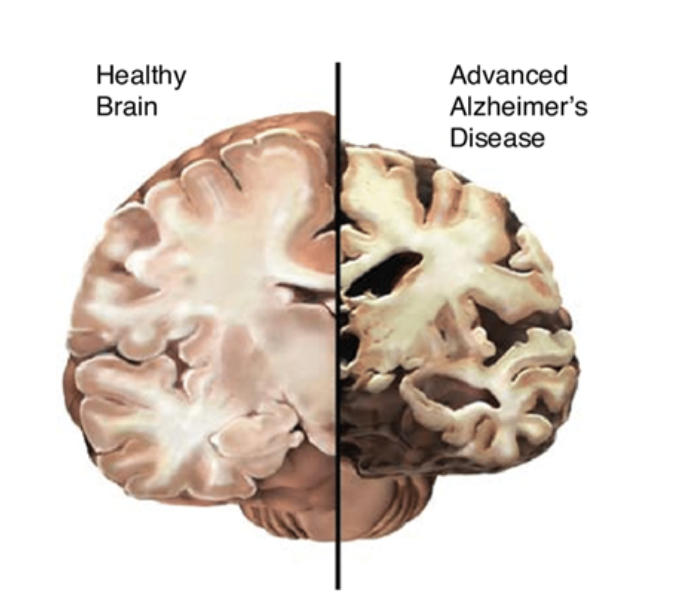
As we’ve already explored what Alzheimer’s is and how it affects the brain, the next question is: could light near infrared play a role in supporting those living with Alzheimer's disease?
Transcranial photobiomodulation (tPBM), the use of specific wavelengths of light to influence brain function, is emerging as a fascinating area of research. But what does this really mean for Alzheimer’s patients, and why are scientists and doctors starting to pay attention?
Let's dive into it!
3 Ways tPBM Could Support Alzheimer’s Patients
Improved Cognition
PBM has been shown to positively influence brainwave activity, particularly in the alpha and gamma ranges, which are crucial for focus and memory. In clinical trials, patients receiving PBM demonstrated improvements in recall, language skills and executive function.
This suggests that light therapy may help strengthen the brain’s communication networks (Saltmarche et al., 2017).
Mitochondrial Rescue
One of the hallmarks of Alzheimer’s is mitochondrial dysfunction. The mitochondria, often described as the brain’s batteries, struggle to produce enough energy to maintain healthy neural activity for carrying out daily tasks like remembering where you put your keys.
PBM works by stimulating the mitochondria, enhancing ATP production and reducing oxidative stress. This cellular recharging may help neurons maintain their structure and function, slowing the progression of energy decline that contributes to neurodegeneration (Salehpour et al., 2019).
Better Blood Flow
Poor circulation means that neurons in memory-critical regions like the hippocampus receive less oxygen and fewer nutrients, worsening cognitive decline. PBM promotes vasodilation, the widening of blood vessels, through the release of nitric oxide.
This not only improves cerebral blood flow but also enhances oxygen delivery and waste clearance. The result is a healthier, more nourished brain environment, which supports synaptic plasticity and memory retention (Chao, 2019).
Key Studies
STUDY #1: PBM for Dementia
Significant Improvement in Cognition in Mild to Moderately Severe Dementia Cases Treated with Transcranial Plus Intranasal Photobiomodulation: Case Series Report Saltmarche et al., 2017.
Who? 5 Patients with Dementia What? PBM daily use for 12 weeks How? Near-infrared light applied via transcranial and intranasal devices to target brain regions associated with memory and cognition.
What They Found:
- Better Memory & Attention scores
- Decrease of Anxiety & Wandering behaviors
- Improved sleep
- No negative side effects
🔑 Daily PBM was safe and improved multiple quality-of-life measures.
STUDY #2: PBM For Alzheimer's Disease
Effects of Home Photobiomodulation Treatments on Cognitive and Behavioral Function, Cerebral Perfusion, and Resting-State Functional Connectivity in Patients with Dementia, Chao, 2019.
Who? 8 patients with mild to moderate AD
What? 810nm PBM 3x per week for 12 weeks
How? Participants used a helmet-like (transcranial & intranasal) to deliver 810 nm near-infrared light at home several times per week, targeting cortical areas involved in cognition.
What They Found:
- Mini-Mental State Exam results increased by 3 points on average
- Improved functional independence in daily living
- Increased cerebral blood flow in fMRI scans
🔑 PBM improved cognition and brain blood flow, even in diagnosed Alzheimer’s patients.
Reimagining Brain Care
Unlike drugs that target single pathways, PBM works on core cellular processes:
- Boosts mitochondrial ATP production (Hamblin, 2016)
- Increases cerebral blood flow (Farivar et al., 2014)
- Reduces neuroinflammation (Salehpour et al., 2019)
- Enhances synaptic plasticity for learning & memory (Chao, 2019)
💡 Alzheimer’s is a complex disease with no single solution but the science of PBM is emerging as a promising therapy that can improve symptoms and quality of life of those affected by Alzheimer’s disease.
References:
World Health Organization (WHO). (2023). Dementia fact sheet. Retrieved from: https://www.who.int/news-room/fact-sheets/detail/dementia
Selkoe, D. J., & Hardy, J. (2016). The amyloid hypothesis of Alzheimer’s disease at 25 years. EMBO Molecular Medicine, 8(6), 595–608.
Wang, Y., & Mandelkow, E. (2016). Tau in physiology and pathology. Nature Reviews Neuroscience, 17(1), 5–21.
Swerdlow, R. H. (2018). Mitochondria and mitochondrial cascades in Alzheimer’s disease. Journal of Alzheimer’s Disease, 62(3), 1403–1416.
Heneka, M. T., Golenbock, D. T., & Latz, E. (2015). Innate immunity in Alzheimer’s disease. Nature Immunology, 16(3), 229–236.
Hamblin, M. R. (2016). Shining light on the head: Photobiomodulation for brain disorders. BBA Clinical, 6, 113–124.
Farivar, S., Malekshahabi, T., & Shiari, R. (2014). Biological effects of low level laser therapy. Lasers in Medical Science, 29(2), 551–559.
Salehpour, F., Mahmoudi, J., Kamari, F., Sadigh-Eteghad, S., Rasta, S. H., & Hamblin, M. R. (2019). Brain photobiomodulation therapy: A narrative review. Molecular Neurobiology, 56(11), 6521–6546.
Chao, L. L. (2019). Transcranial near-infrared light therapy for Alzheimer’s disease: A randomized, controlled clinical trial. Journal of Alzheimer’s Disease Reports, 3(1), 1–13.
Saltmarche, A., Naeser, M. A., Ho, K. F., Hamblin, M. R., & Lim, L. (2017). Significant improvement in cognition in mild to moderately severe dementia cases treated with transcranial plus intranasal photobiomodulation: Case series report. Photomedicine and Laser Surgery, 35(8), 432–441.
![[object Object]](https://cdn.sanity.io/images/h29o7kl4/staging/0c0476690b5e49f9a375deb663c4d52aa39fa8e2-352x351.heif?w=352&q=80&auto=format&fit=max)