What Is Light Therapy?
Dive into the science of light therapy, learning about its mechanisms, wavelengths and applications.
Your Brain Deserves Attention Too
We fuel our bodies with good food, exercise, and regular check-ins like eye exams and bloodwork - but we often forget about the organ running the whole show. Your brain deserves that same attention.
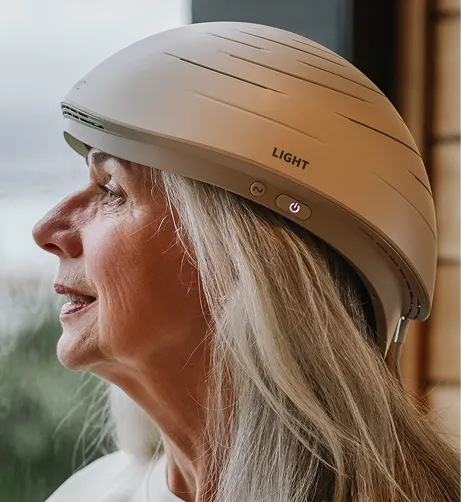
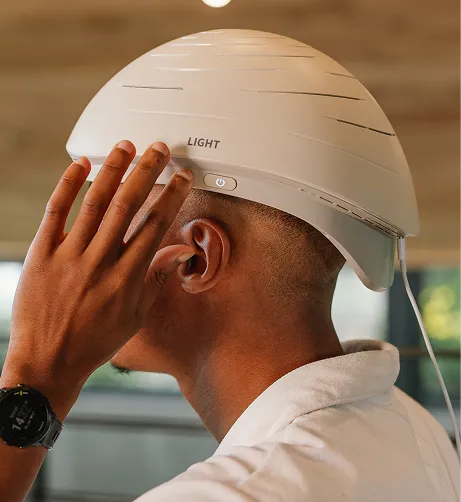
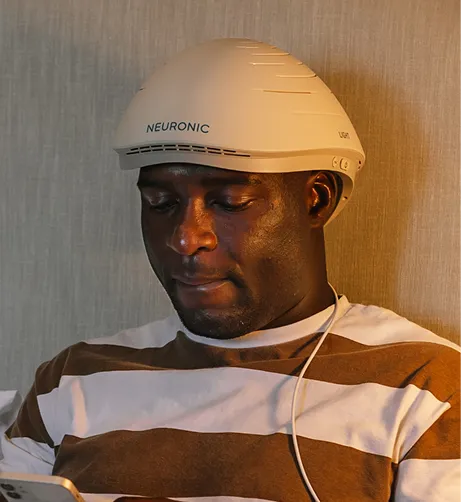
Transcranial photobiomodulation (tPBM), also known as light therapy for the brain, uses gentle near-infrared (NIR) light to help your brain function at its best. Whether you’re looking to boost focus and mood or support long-term cognitive resilience, tPBM can help give your brain the care it deserves and the energy it needs to thrive.
What Is Light Therapy?
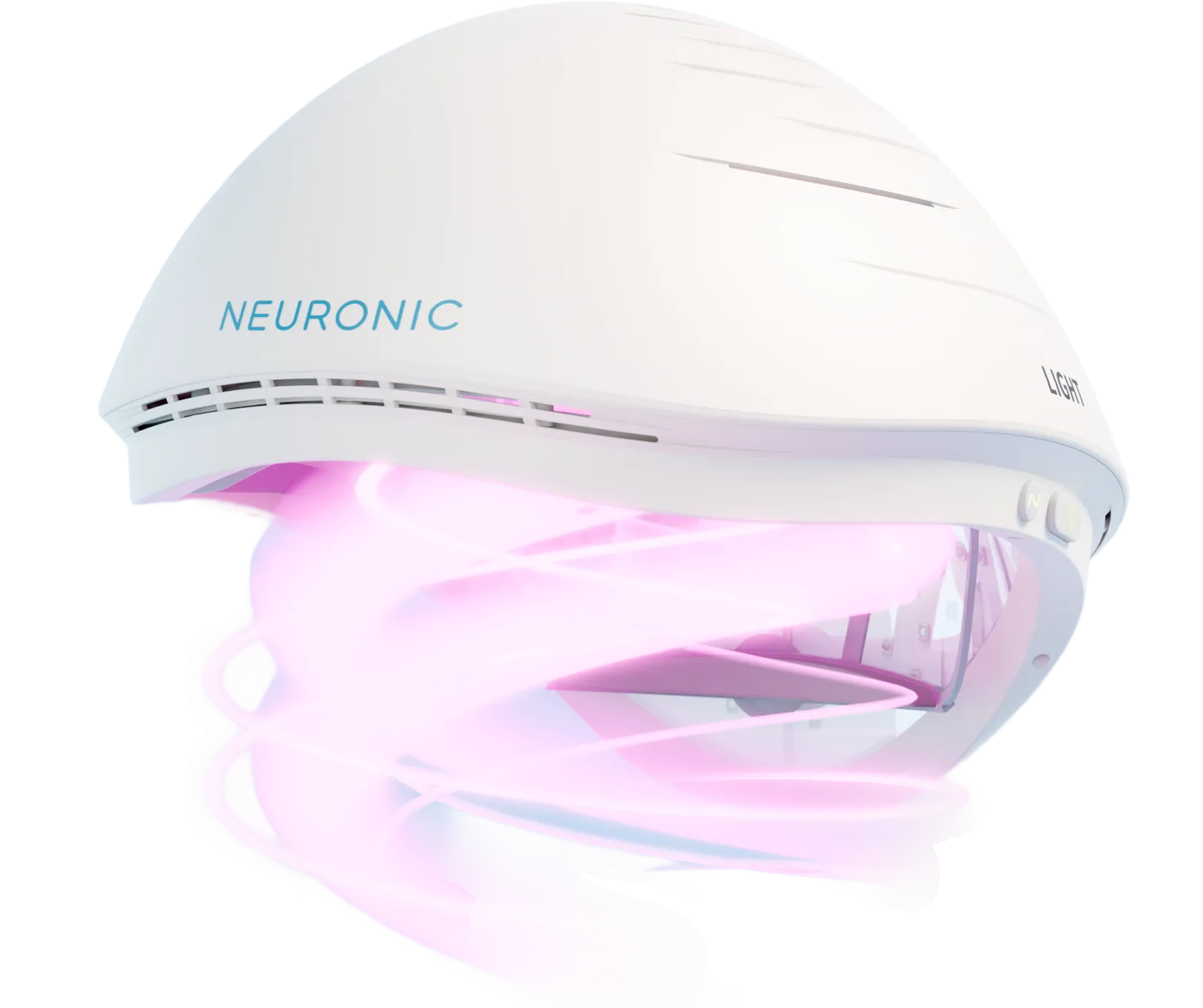
Light therapy, or photobiomodulation (PBM), is the use of specific wavelengths of light to boost your body’s natural energy systems. Wavelengths of red (~620-750 nm) and near infrared (~750-1400 nm) light are used for therapeutic purposes and are increasingly gaining the attention of researchers. These wavelengths occur naturally and have known wellness properties but, oftentimes, we don't get sufficient daily exposure. Photobiomodulation can harness these natural energy boosters to support brain health.
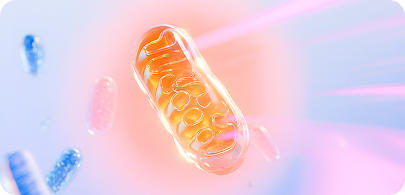
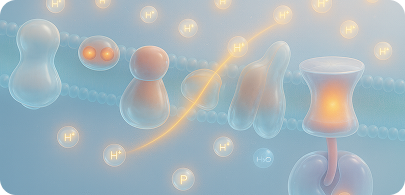
When absorbed by your cells’ mitochondria - the battery of your cell - near-infrared light helps produce more ATP (adenosine triphosphate),ATP (adenosine triphosphate), the molecule that powers every cellular process (Salehpour et al., 2018). Many additional downstream mechanisms occur in the cell, such as the release of nitric oxide, which then translate to bigger noticeable changes in day-to-day life.
The Role of Mitochondria in Light Therapy
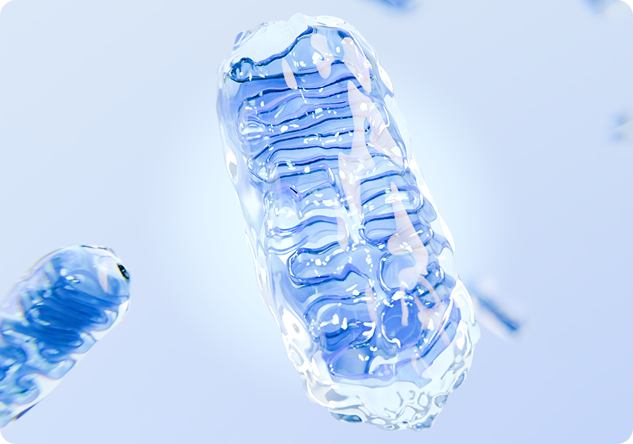
Mitochondria are often called the "powerhouse of the cell" because they produce ATP, the energy currency your cells rely on to function and heal. They play a critical role in brain health, inflammation control, and cellular repair.
PBM works in part by targeting a mitochondrial enzyme called cytochrome-c-oxidase (CCO). When near-infrared light reaches the mitochondria, it helps this enzyme work more efficiently, leading to:
- Improved energy production (ATP)
- Decreased inflammation
- Increased circulation
- Enhanced cellular repair and resilience
In simple terms, PBM supports mitochondrial function, helping your brain and body operate more efficiently.
Benefits of Light Therapy
5 Reasons We Use 1070 nm
Photobiomodulation researchers have researched many wavelengths, primarily in the red and near-infrared spectrum. Using a combination of what we know about the physics of light, its applications to biology, and PBM mechanisms, we chose the 1070 nm to deliver near-infrared light that would be both safe and effective.
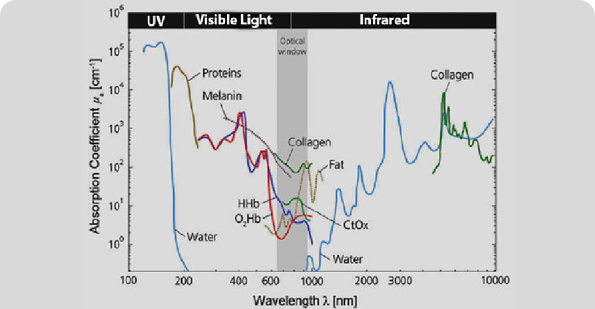
1: An Ideal Absorption Index
When light enters the body, much of it is absorbed by biological materials and molecules, such as melanin, water, and hemoglobin. However, research shows two optimal “optical windows” (600-800 nm and 1040-1070 nm), that are able to reduce this absorption and target CCO in the mitochondria more effectively than other wavelengths (Penberthy & Vorwaller, 2021). 1070 nm was chosen for its superior tissue penetration and reduced absorption.
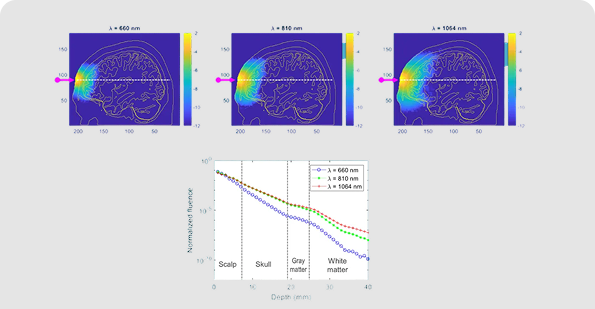
2: Reduced Scattering and Deeper Reach
Research shows that 1064 nm light scatters far less than shorter wavelengths like 810 nm, allowing it to penetrate deeper into tissue, with 47% of photons still measurable at 6.17 mm, compared to only 26% for 810 nm (Marshall & Vlková, 2020). This reduced scattering, combined with lower hemoglobin, melanin and water absorption in the 1000-1070 nm range, means more light can penetrate to greater depths, including the cortex, and drive beneficial biological effects such as CCO activity.
3: Longer Lasting Effects
While we know near infrared wavelengths have a biological impact, Pruitt et al. (2022) found that the 1064 nm wavelength sustained greater biological effects compared to the 810 nm wavelength.
Note: We do not want significant absorption by hemoglobin while light is penetrating the tissues, but increased hemoglobin activity as a result of CCO activation provides hemodynamic biomarkers that confirm PBM-driven metabolic activation.
Dashed lines = 1064 nm, solid lines = 800 nm. Image taken from Pruitt et al., (2022).

Δ[HbO] - Oxygenated Hemoglobin
1064 nm drives a much stronger rise in HbO, indicating superior increases in cerebral blood flow and oxygen delivery to active tissue.
Δ[HHb] - Deoxygenated Hemoglobin
Greater HHb increases at 1064 nm show higher oxygen extraction, reflecting elevated neuronal and metabolic demand during stimulation.
Δ[oxCCO] - Oxidized Cytochrome-c-Oxidase
1064 nm produces a pronounced rise in oxCCO, demonstrating stronger mitochondrial activation and enhanced ATP-generating capacity.
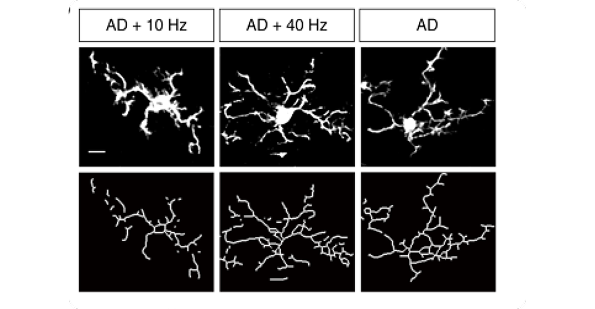
4: Glial Cell Modulation
Research on animal models suggests that 1070 nm near-infrared light helps shift microglia that are in an inflammatory state back toward their anti-inflammatory, restorative role, supporting the brain’s natural homeostasis. This wavelength has also been linked to reduced amyloid-beta buildup and improved cellular repair (Tao et al., 2021), making it a powerful target for promoting long-term brain health and resilience.
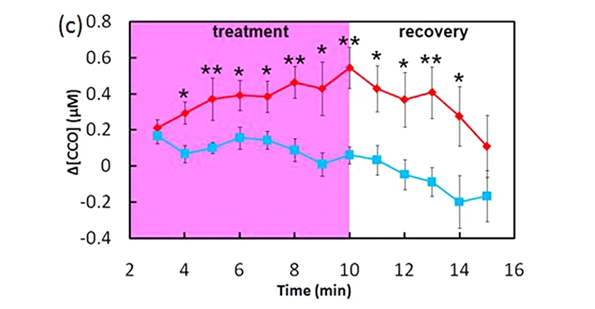
5: Calcium Gates and Cytochrome C Oxidase
The 1070 nm wavelength not only stimulates CCO, the primary photoreceptor in PBM (Wang et al., 2016), but also activates light-sensitive ion channels, increasing intracellular Ca²⁺ (Dompe et al., 2020). This cascade influences ROS, nitric oxide, and cyclic adenosine monophosphate signaling, ultimately enhancing transcription factors involved in cell growth, repair, and survival.
Understanding Key Photobiomodulation Terminology
Creating a tPBM device involves a lot of considerations like wavelength, power, and irradiance. Let’s take a look at what all these words mean and how they relate to light therapy:
Wavelength (nm)
Wavelength refers to the distance between consecutive peaks of a light wave, measured in nanometers (nm). It determines the color and depth of penetration of light. For example, near-infrared wavelengths (800–1100 nm) penetrate deeper into the brain and body than visible red light (around 600–700 nm), making them ideal for transcranial photobiomodulation (tPBM).
Power (W or mW)
Power is the total amount of energy emitted per second from the light source, measured in watts (W) or milliwatts (mW). In light therapy, power reflects how much light energy the device produces overall. Higher power doesn’t always mean better – what matters is delivering the right dose safely and effectively to target tissues.
Irradiance (mW/cm²)
Irradiance is the power delivered per unit of area, measured in milliwatts per square centimeter (mW/cm²). It represents how concentrated the light is when it hits the skin or scalp. This is a key factor in determining treatment dosage, as it affects how much light actually reaches the cells beneath the surface.
Frequency (Hz)
In light therapy, frequency can describe either:
- The pulsing rate of the light (how many times per second it turns on and off), measured in Hertz (Hz)
- The optical frequency of the light wave itself (related to wavelength).
Intensity/Duty Cycle (%)
Duty cycle describes the percentage of time the light is on during a pulsed cycle. For example, a 50% duty cycle means the light is on half the time and off half the time. Adjusting duty cycle changes the average power delivered, which can affect tissue heating, comfort, and biological response. Most tPBM research surrounds continuous wave light, which means there is no pulse rate. In this case, the intensity/duty cycle must be no less than 100%.
The science behind how these concepts inform our devices.
Listen & learn from experts in the fields of light therapy, neurotechnology, and beyond. Watch previous rounds or subscribe to be notified about our next rounds.
Learn MoreThe History of Light Therapy
Learn more about the history of light therapy with Michael R Hamblin, PhD.
Scientific Evidence: 10,000+ PBM Studies & Benefits
Research in the field of red light and near-infrared light therapy shows many promising results such as:
References
- Dompe, C., Moncrieff, L., Matys, J., Grzech-Leśniak, K., Kocherova, I., Bryja, A., Bruska, M., Dominiak, M., Mozdziak, P., Skiba, T. H. I., Shibli, J. A., Angelova Volponi, A., Kempisty, B., & Dyszkiewicz-Konwińska, M. (2020). Photobiomodulation–underlying mechanism and clinical applications. Journal of Clinical Medicine, 9(6), 1724. https://doi.org/10.3390/jcm9061724
- González-Lima, F., Tian, F., & Liu, H. (2020, February). Effects of wavelength on transcranial laser stimulation: A Monte Carlo simulation study based on standard brain model. In Mechanisms of Photobiomodulation Therapy XV (Vol. 11221, p. 112210 B). SPIE. https://doi.org/10.1117/12.2545286
- Hernández-Bule, M. L. et al. (2024). Unlocking the Power of Light on the Skin: A Comprehensive Review on Photobiomodulation. Photobiomodulation, Photomedicine & Laser Surgery. PMC free article. doi: 10.3390/ijms25084483
- Johnstone, D. M., Moro, C., Stone, J., Benabid, A.-L., & Mitrofanis, J. (2016). Turning on lights to stop neurodegeneration: The potential of near-infrared light therapy in Alzheimer’s and Parkinson’s disease. Frontiers in Neuroscience, 9, 500. https://doi.org/10.3389/fnins.2015.00500
- Leal-Junior, E. C., Lopes-Martins, R. A., & Vanin, A. A. (2015). Photobiomodulation therapy in skeletal muscle: From exercise performance to muscular dystrophies. Photomedicine & Laser Surgery, 33(2), 53–54. https://doi.org/10.1089/pho.2015.9851
- Marshall, R. P., & Vlková, K. (2020). Spectral dependence of laser light on light–tissue interactions and its influence on laser therapy: An experimental study. Insights in Biomedicine, 5(1), 1. https://doi.org/10.36648/2572-5610.5.1.66
- Mineroff, J., Maghfour, J., Ozog, D. M., Lim, H. W., Kohli, I., & Jagdeo, J. (2024). Photobiomodulation CME part II: Clinical applications in dermatology. Journal of the American Academy of Dermatology, 91(5), 805-815. https://doi.org/10.1016/j.jaad.2023.10.074
- Penberthy, W. T., & Vorwaller, C. E. (2021). Utilization of the 1070 nm wavelength in photobiomodulation: A systematic review and meta-analysis. Journal of Lasers in Medical Sciences, 12, e86. https://doi.org/10.34172/jlms.2021.86
- Pruitt, T., Carter, C., Wang, X., Wu, A., & Liu, H. (2022). Photobiomodulation at different wavelengths boosts mitochondrial redox metabolism and hemoglobin oxygenation: Lasers vs. light-emitting diodes in vivo. Metabolites, 12(2), 103. https://doi.org/10.3390/metabo12020103
- Salehpour, F., Mahmoudi, J., Kamari, F., Sadigh-Eteghad, S., Rasta, S. H., & Hamblin, M. R. (2018). Brain photobiomodulation therapy: A narrative review. Molecular Neurobiology, 55(8), 6601-6636. https://doi.org/10.1007/s12035-017-0852-4
- Salehpour, F., Majdi, A., Pazhuhi, M., Ghasemi, F., Khademi, M., Pashazadeh, F., Hamblin, M. R., & Cassano, P. (2019). Transcranial photobiomodulation improves cognitive performance in young healthy adults: A systematic review and meta-analysis. Photobiomodulation, Photomedicine & Laser Surgery, 37(10), 635-643. https://doi.org/10.1089/photob.2019.4673
- Santos, E. A. B., Lucena, R. J. R. S., Lima, E. G., Lins, L. T., & Rodrigues, M. A. B. (2019). Low-cost functional near-infrared spectroscopy (fNIRS) applied on brain-computer interfaces (BCIs). In R. Costa-Felix et al. (Eds.), XXVI Brazilian Congress on Biomedical Engineering: IFMBE Proceedings (Vol. 70/1, pp. 495-500). Springer. https://doi.org/10.1007/978-981-13-2119-1_76
- Tao, L., Liu, Q., Zhang, F., Fu, Y., Zhu, X., Weng, X., Han, H., Huang, Y., Suo, Y., Chen, L., Gao, X., & Wei, X. (2021). Microglia modulation with 1070-nm light attenuates Aβ burden and cognitive impairment in Alzheimer’s disease mouse model. Light: Science & Applications, 10(1), 179. https://doi.org/10.1038/s41377-021-00617-3
- Wang, X., Tian, F., Soni, S. S., Gonzalez-Lima, F., & Liu, H. (2016). Interplay between up-regulation of cytochrome c oxidase and hemoglobin oxygenation induced by near-infrared laser. Scientific Reports, 6, Article 30540. https://doi.org/10.1038/srep30540
- Zeng, J., Wang, C., Chai, Y., Lei, D., & Wang, Q. (2024). Can transcranial photobiomodulation improve cognitive function in TBI patients? A systematic review. Frontiers in Psychology, 15. https://doi.org/10.3389/fpsyg.2024.1378570